
How to Start Investing in 2024: A Beginner’s Guide to Building Wealth
Many of us grew up thinking that investing was a world reserved for Wall Street professionals in expensive suits, a complex and intimidating game for the rich. The media often reinforces this idea, portraying the stock market as a scary place where you need a finance degree and a massive fortune to even participate.
Fortunately, that image is completely outdated. You can start investing today, even if you have very little money and no financial background. In fact, you should start as soon as possible. Building a solid investment portfolio is one of the most effective ways to secure a comfortable retirement and achieve long-term financial freedom.
But where do you begin? This guide will walk you through everything you need to know, step by step. You’ll discover that starting your investment journey is far easier and more accessible than you ever imagined.
Disclaimer: This article is intended for educational purposes only. I am not a financial advisor, and this content should not be considered investment advice. Please consult with a qualified professional before making any financial decisions.
Why You Absolutely Must Start Investing
Why not just keep your money in a savings account or tucked away safely at home? Isn’t investing inherently risky? While all investments carry some level of risk, the risk of not investing is arguably greater over the long term. The primary reason for this is a silent wealth-destroyer called inflation.
Historically, the average annual rate of inflation in the U.S. is about 3%. This means that, on average, the cost of goods and services increases by 3% each year. Your money, in turn, loses 3% of its purchasing power. While that might not sound like a lot, its effect over decades is devastating.
Let’s put that into perspective. If you hide $10,000 in cash, after 20 years of 3% inflation, it will only have the purchasing power of about $5,500 today. You haven’t lost a single dollar, but you’ve lost nearly half of its value.
You might think a high-yield savings account is the answer. However, according to the FDIC, the average savings account interest rate is typically well below 1%. Even the most competitive online savings accounts struggle to consistently beat the rate of inflation. By relying solely on saving, you are, at best, treading water. To truly grow your wealth and build a nest egg for retirement, your money needs to work for you. That’s where investing comes in.
Understanding the Basics: What is Investing?
At its core, investing is the act of allocating money to an asset with the expectation of generating a profit or future income. This could be anything from real estate to fine art. For most beginners, however, investing primarily involves two main types of assets: stocks and bonds.
Stocks: Owning a Piece of a Company
A stock represents a small piece of ownership, or a “share,” in a publicly-traded company. When you buy a share of a company like Apple or Amazon, you become a part-owner. As an investor, your goal is for the company to succeed and grow, causing the value of your shares to increase. You can then sell those shares for a profit. Stocks offer the potential for high returns but also come with higher risk, as a company’s value can also decrease.
Bonds: Loaning Money for a Return
A bond is essentially a loan you make to a government or a corporation. In exchange for your money, the entity agrees to pay you back the full amount (the principal) on a specific date, along with regular interest payments along the way. Bonds are generally considered much safer than stocks because their returns are more predictable. However, this lower risk also means they typically offer lower potential returns.
A smart investment strategy usually involves a mix of both stocks and bonds to balance growth potential with stability. This principle is known as diversification.
ETFs: The Beginner’s Best Friend
Instead of trying to pick individual stocks and bonds, which can be risky and time-consuming, most beginners are better off using Exchange-Traded Funds (ETFs). Think of an ETF as a “basket” that holds hundreds or even thousands of different stocks and bonds, all bundled together into a single, tradable share.
When you buy a share of an ETF, you are instantly diversifying your investment across a wide range of companies and industries. For example, an S&P 500 ETF gives you a tiny piece of the 500 largest companies in the United States. This broad diversification significantly reduces your risk. If a few companies in the basket perform poorly, the success of the others helps to balance it out.
ETFs offer several key advantages for new investors:
- Instant Diversification: Spreading your money across many assets reduces risk.
- Low Cost: You can buy a share of an ETF for a fraction of the cost of buying all the individual stocks it contains.
- Simplicity: They are incredibly easy to buy and sell through any standard brokerage account.
- Passive Management: You don’t have to spend hours researching individual companies. The fund does the work for you.
The Secret Weapon for Wealth: Compound Interest
The single most powerful force in investing is compound interest. It’s the concept of earning returns not just on your initial investment, but also on the accumulated returns from previous periods. It creates a snowball effect that can turn a small, consistent investment into a massive fortune over time.
Let’s look at a powerful example:
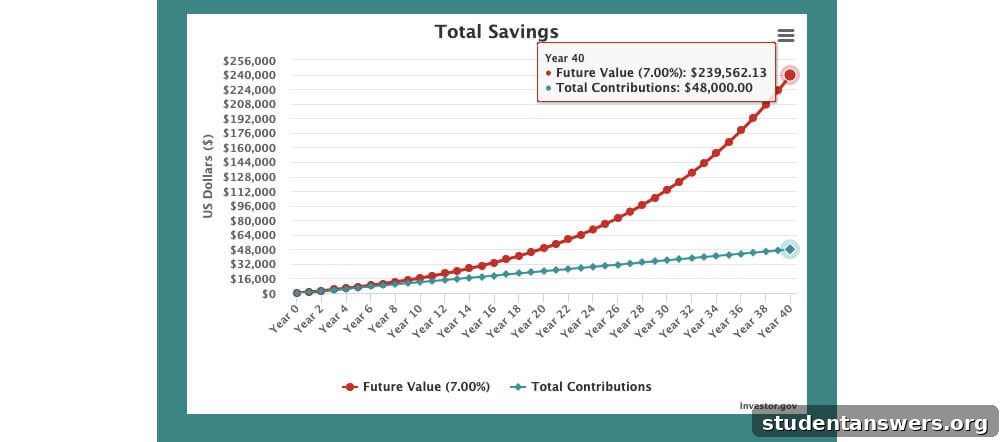
Imagine you invest $100 every month for 40 years. Your total contribution would be $48,000. If that money just sat in a non-interest-bearing account, you’d have exactly $48,000.
Now, let’s say you invest that same $100 per month into a diversified portfolio of ETFs that earns an average annual return of 7% (a historically reasonable expectation). After 40 years, your investment wouldn’t be worth $48,000. It would be worth nearly $240,000.
The difference of roughly $192,000 is purely the result of compound interest. The longer your money has to grow, the more dramatic the effect becomes. This is why it’s so critical to start investing as early as possible.
How to Start Investing Today: A Simple 3-Step Plan
Ready to put your money to work? This straightforward, three-step plan is designed for beginners and requires no special knowledge or large sums of money. It’s a proven, long-term strategy that prioritizes consistency and simplicity.
Step 1: Leverage Tax-Advantaged Retirement Accounts
Your first priority should always be to invest through tax-advantaged retirement accounts like a 401(k) or an IRA. These accounts offer significant tax benefits that supercharge your investment growth.
If your employer offers a 401(k) plan, especially one with an employer match, contribute to it before investing anywhere else. An employer match is when your company contributes money to your account to match your own contributions, up to a certain percentage. This is literally free money and offers an immediate 100% return on your investment. At a minimum, contribute enough to get the full employer match.
If you don’t have a 401(k) or have already maxed out your contributions, open an Individual Retirement Account (IRA). An IRA is an account you open on your own that also offers powerful tax advantages. You can open an IRA at almost any major brokerage firm.
Step 2: Open a Brokerage Account and Invest Consistently
After you’ve addressed your retirement accounts, you can invest any additional money in a standard taxable brokerage account. For beginners, a low-fee platform with a user-friendly interface is ideal. Many modern brokerage firms, often called “robo-advisors,” allow you to open an account with no minimum deposit and offer commission-free trading on stocks and ETFs.
The key to success is automation. Set up automatic, recurring transfers from your bank account to your brokerage account every week or month. This strategy, known as dollar-cost averaging, ensures you invest consistently, regardless of what the market is doing. It removes emotion from the equation and builds a disciplined investing habit.
Step 3: Adopt a Long-Term Mindset (And Don’t Panic!)
The stock market goes up and down. This is normal. There will be days, weeks, or even years where your portfolio value declines. It can be tempting to panic and sell your investments to avoid further losses. This is the single biggest mistake an investor can make.
Remember, you are investing for the long term—for goals that are decades away. Short-term market fluctuations are just noise. History has shown that over any 20-year period, the stock market has always trended upward. Stay the course, continue your automatic investments, and trust the process. In fact, market downturns are opportunities to buy assets at a discount.
Rookie Mistakes: 4 Common Investing Traps to Avoid
As you begin your journey, be aware of these common pitfalls that can derail your progress.
- Listening to ‘Hot Tips’: Your friend or family member might swear by a “can’t-miss” stock tip. Politely ignore it. Successful investing is built on a disciplined strategy, not on speculation or hearsay. Stick to your plan of investing in broad-market ETFs.
- Trying to ‘Beat the Market’: Many new investors believe they can outsmart the market by picking winning stocks or timing its movements. The data shows this is nearly impossible. Even the vast majority of professional fund managers fail to outperform simple index funds over the long run. Don’t waste your time and energy trying to do what the pros can’t.
- Chasing Get-Rich-Quick Schemes: Investing is a long-term strategy for building wealth, not a lottery ticket. Be wary of anything that promises guaranteed, high returns in a short period. True wealth is built slowly and steadily.
- Panic Selling During a Market Dip: As mentioned before, this is worth repeating. Your emotions are your biggest enemy as an investor. When the market falls, the worst thing you can do is sell. The best thing you can do is stick to your plan or even invest more if you can.
Frequently Asked Questions About Investing
Here are answers to some common questions that new investors often have.
What returns can I realistically expect?
While past performance is no guarantee of future results, the historical average annual return of the S&P 500 (a good proxy for the overall U.S. stock market) has been around 7-10% after adjusting for inflation. It’s wise to use a more conservative estimate, like 7%, for long-term planning. Remember, this is an average; returns in any single year can vary wildly.
How much money do I need to start investing?
Thanks to fractional shares and zero-commission brokers, you can start with as little as $1. The excuse of “not having enough money” is no longer valid. The most important thing is to start, no matter how small the amount, and build the habit of consistent investing.
Should I pay off debt or invest?
This is a common dilemma. A good rule of thumb is to compare the interest rate on your debt to your expected investment return. If you have high-interest debt, such as credit card debt (often 15%+), you should prioritize paying that off before investing aggressively. The guaranteed return of eliminating that debt is higher than what you could reliably earn in the market. For low-interest debt (like mortgages or some student loans under 5%), it often makes mathematical sense to invest while making your regular debt payments.
Are there fees to invest?
Yes, but they can be minimized. Most reputable brokers now offer commission-free trading for stocks and ETFs. However, ETFs themselves have a small internal fee called an “expense ratio.” Look for funds with very low expense ratios (ideally under 0.10%). While a 1% fee might sound small, over decades it can consume hundreds of thousands of dollars of your returns.
The Best Time to Invest Was Yesterday. The Next Best Time is Now.
This guide has given you the foundational knowledge to begin your investing journey. The most crucial takeaway is to take action. The power of compound interest is fueled by time, and the sooner you start, the more powerful it becomes.
Don’t wait for the “perfect” moment or until you have more money. Start today. Open a retirement account, contribute enough to get your employer match, and set up a low-cost brokerage account. Automate your investments in a diversified ETF, and then let your money work for you over the long term. Your future self will thank you for it.