

Master Your Schedule: Expert Time Management Strategies That Actually Work
Let’s be honest: have you ever felt like your to-do list is a hydra, growing two new tasks for every one you complete? You start your day with a clear plan, feeling motivated and in control. You dive into a project, find your rhythm, and then it happens. An email notification pops up. A colleague asks for a “quick favor.” You tell yourself, “This will only take a minute. I’ll just get it out of the way now.”
But that “one minute” turns into twenty. That quick favor unravels into a complex problem. Suddenly, the focus you had is shattered. You’re behind schedule, stressed, and the momentum you built has vanished. This isn’t just a personal failing; it’s a universal struggle. We’re often our own worst enemies when it comes to managing our most valuable, non-renewable resource: time.
Many of us struggle with scheduling, others are masters of procrastination, and some are easily derailed by the smallest distraction. Whatever your particular challenge may be, this guide is designed to help. First, we’ll explore the psychological reasons why time management is such a common hurdle. Then, we’ll dive deep into three powerful, actionable strategies from leading productivity experts to help you reclaim your time and achieve your goals.
The Psychology of Procrastination: Why Time Management Is So Hard
A quick search for “time management tips” unleashes a flood of billions of results, each promising the ultimate hack or app to solve your productivity woes. But before you dive into that overwhelming rabbit hole of best practices, it’s crucial to understand the root of the problem. You can’t effectively fix something if you don’t know why it’s broken. Here are two fundamental reasons we often fail at managing our time.
1. We Suffer from “Analysis Paralysis”
When tasks pile up and deadlines loom, it’s easy to feel overwhelmed. Your inbox is overflowing, your calendar is a chaotic mess, and everyone seems to need a piece of your time. In these moments of high stress, we often turn on ourselves, convinced we are simply “bad” at managing time. This triggers a panic response where we try to regain control by obsessing over the system itself.
We spend hours reorganizing our digital calendars, color-coding our to-do lists, and endlessly researching new productivity apps. While this feels productive, it’s a clever form of procrastination. All this time spent worrying about the “correct” way to manage time distracts us from the one thing that truly matters: starting the work.
Author and entrepreneur Charlie Gilkey brilliantly pinpoints this issue, suggesting that our problems lie deeper than the clock. He argues:
“People who think they have time management problems really have priority management problems, which means, at root, they have self-management problems… One of the chief jobs of the leaders is to ensure that people are addressing the most important priorities in any given slice of time.”
In essence, time management shouldn’t be a task in itself. When we fixate on perfecting the system, we avoid making the tough decisions about what truly deserves our attention. The goal is not to have a perfect schedule; it’s to take meaningful action on your most important tasks.
2. We Are Victims of the “Planning Fallacy”
Do you consistently underestimate how long a task will take? You’re not alone. This is a well-documented cognitive bias known as the planning fallacy. It describes our natural tendency to be overly optimistic about our own efficiency while underestimating the time and resources required to complete a future task, even when we have past experiences to prove otherwise.
A classic 1994 study highlighted this perfectly. Researchers asked a group of psychology students to estimate how long it would take to complete their senior theses. On average, the students predicted it would take 34 days. When asked for a worst-case scenario estimate, they guessed 49 days. The reality? The average completion time was a staggering 55.5 days. Only 30% of students finished within their originally predicted timeframe.
The planning fallacy can completely dismantle your schedule before your day even begins. If you believe an essay will take three hours when it really requires five, your entire plan is thrown into disarray. This creates a domino effect of stress and missed deadlines. The solution is simple yet powerful: build a buffer into everything you schedule. If you think a report will take two hours, block out three. If a workout usually takes 45 minutes, schedule a full hour. This proactive approach gives you breathing room for unexpected delays. And if you finish early? You’ve just gifted yourself valuable free time.
3 Expert-Backed Time Management Strategies to Reclaim Your Day
Understanding the “why” behind our struggles is the first step. Now, let’s move on to the “how.” Here are three proven methods from renowned experts that can help you build a robust and effective time management system.
1. Master Your Day with Time Blocking
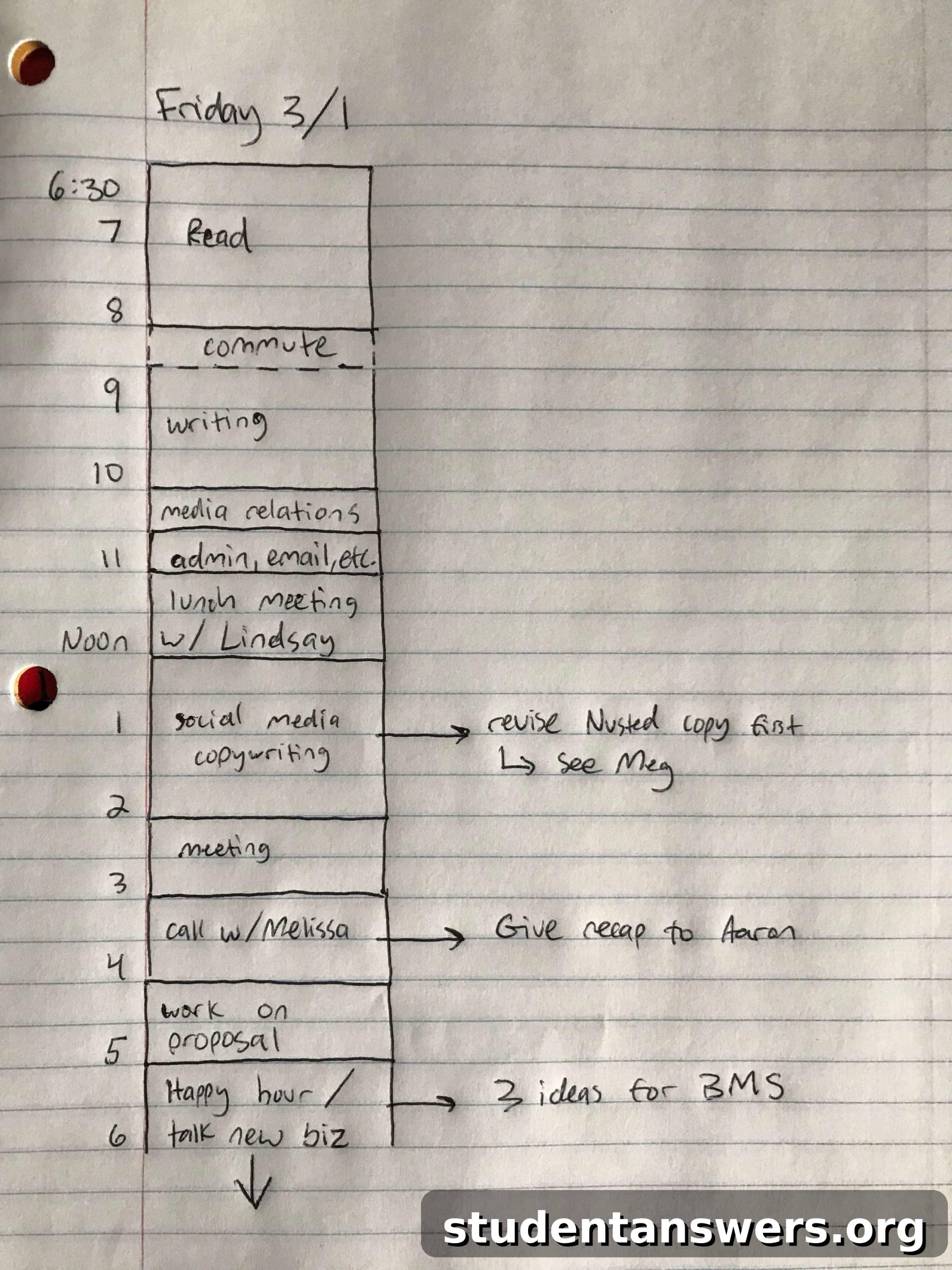
Cal Newport, a computer science professor and the author of the influential book Deep Work, is a leading voice in productivity. He champions a method called time blocking, which involves planning every minute of your workday in advance. This isn’t just about listing tasks; it’s about assigning every single task to a specific block of time on your calendar.
In a time-blocked schedule, there is no ambiguity. From 9:00 AM to 11:00 AM, you’re writing your report. From 11:00 AM to 11:30 AM, you’re responding to important emails. Even breaks, lunch, and transit time get their own dedicated blocks. This zero-sum approach eliminates the mental energy wasted on deciding what to do next, allowing you to pour all your focus into the task at hand.
Here’s how to implement time blocking:
- List Your Tasks: Start by capturing everything you need to accomplish for the day, including work assignments, personal errands, exercise, and meals.
- Estimate and Buffer: Look at each task and estimate the time it will take, then add a 25-50% buffer to counteract the planning fallacy.
- Build Your Blocks: Open your calendar and start assigning each task to a specific time slot. Begin with your fixed appointments (like classes or meetings) and then fill in the gaps with your task blocks. Be realistic and include breaks.
A time-blocked day provides structure and intentionality. If a distraction arises, you can simply point to your schedule and know you don’t have time for it. If your schedule gets disrupted—which it inevitably will—you simply take a moment to rearrange the remaining blocks. The goal isn’t rigid adherence but mindful planning.
2. Win Your Morning with a “Power Hour”
Not all work is created equal. Time management expert Laura Vanderkam distinguishes between “shallow work” and “real work.” Shallow work includes tasks like answering emails, organizing files, or attending routine meetings. These activities can make you feel busy, but they rarely move the needle on your most important goals. “Real work,” or deep work, refers to the high-value projects that require intense focus and creative energy.
Vanderkam suggests starting your day with a “power hour”—a single, uninterrupted hour dedicated to your highest-priority project. This strategy leverages the fact that for most people, willpower and cognitive energy are at their peak in the morning, before the day’s distractions take their toll.
“Recognize that certain aspects of work will expand to fill all available space,” Vanderkam explains, with email being a primary culprit. By tackling your most challenging task first, you ensure that it gets done. Waiting until the afternoon, after your energy has been depleted by countless minor tasks, makes it exponentially harder to engage in deep, focused work. If you build this habit, you can make significant progress on your biggest goals before most people have even finished their first cup of coffee.
3. Unleash Your Potential with a “Not-To-Do” List
Productivity is often framed as a game of addition: doing more, checking off more items, and filling every moment. But what if the real key to getting more done is actually *doing less*? This is the philosophy behind the “not-to-do list,” a concept popularized by author and entrepreneur Tim Ferriss.
In his famous blog post, “The Not-To-Do List: 9 Habits to Stop Now,” Ferriss makes a simple but profound point: “what you don’t do determines what you can do.” Every day is finite. If your schedule is cluttered with low-impact activities, time-wasting habits, and unnecessary obligations, you’ll never have the space for the things that truly matter.
Creating your own not-to-do list requires a period of self-analysis. Track your time for a week and identify your biggest time sinks. Your list might include items like:
- Do not check email or social media for the first hour of the day.
- Do not attend meetings that don’t have a clear agenda and end time.
- Do not say “yes” to requests immediately; instead, say “Let me check my schedule and get back to you.”
- Do not multitask while working on an important project.
As Ferriss notes, “It’s hip to focus on getting things done, but it’s only possible once we remove the constant static and distraction.” By proactively deciding what you will *not* do, you set powerful boundaries that protect your time and focus for what is truly essential.
Manage Your Time on Your Terms
Ultimately, time management is a deeply personal practice. It’s an art as much as a science. While systems and strategies provide an essential framework, the true skill lies in your ability to adapt them to your unique personality, lifestyle, and goals. What works wonders for a university student might not work for a freelance designer. The best time management system isn’t the most popular one—it’s the one you can stick with consistently.
Taking control of your schedule is an ongoing process of experimentation and refinement. No one has a perfect system. The goal is progress, not perfection. So, take a deep breath, stop searching for the perfect hack, pick one strategy from this article, and most importantly, just get started.