

How to Get Better at Math: A Guide to Effective and Lasting Improvement
Despite overwhelming research showing that mathematical ability is a skill that’s built, not born, it’s easy to fall into the trap of thinking, “I’m just bad at math.” Let’s be honest: math can be incredibly challenging. It’s a discipline built like a towering skyscraper, where each new floor rests entirely on the one below it. If even one foundational concept is shaky, the whole structure risks collapsing when you face complex problems or a high-stakes exam.
This cumulative nature is what makes math so intimidating. A small gap in your understanding of fractions in elementary school can become a massive chasm when you’re trying to grasp algebra. That’s why so many students experience teeth-grinding frustration during late-night study sessions and a racing heart when the test paper is placed in front of them.
So, what’s the solution? How do you genuinely get better at math, not just for the next test, but for the long term? The answer lies in a strategy that psychologist Anders Ericsson famously termed deliberate practice. In his groundbreaking book, Peak: Secrets from the New Science of Expertise, he defines it as “purposeful practice that knows where it is going and how to get there.”
This isn’t about mindlessly drilling problems you already know how to solve. It’s about intentionally seeking out problems that are just beyond your current abilities and methodically working through them. If a problem is too difficult, the strategy involves finding a slightly easier one to conquer first, building your skills brick by brick. This principle is the key to unlocking your mathematical potential. In this guide, we’ll explore five actionable tips to help you apply deliberate practice and transform your relationship with math.
Tip #1: Deconstruct Complex Problems into Simpler Components
“If you can’t solve a problem, then there is an easier problem you can solve: find it.”
— George Pólya, How to Solve It
One of the most powerful skills in mathematics is the ability to look at a complex, intimidating problem and break it down into smaller, manageable parts. To master any problem, you must first identify the individual concepts at play, isolate them, and practice each one until it’s second nature. Let’s look at this summation problem as an example:
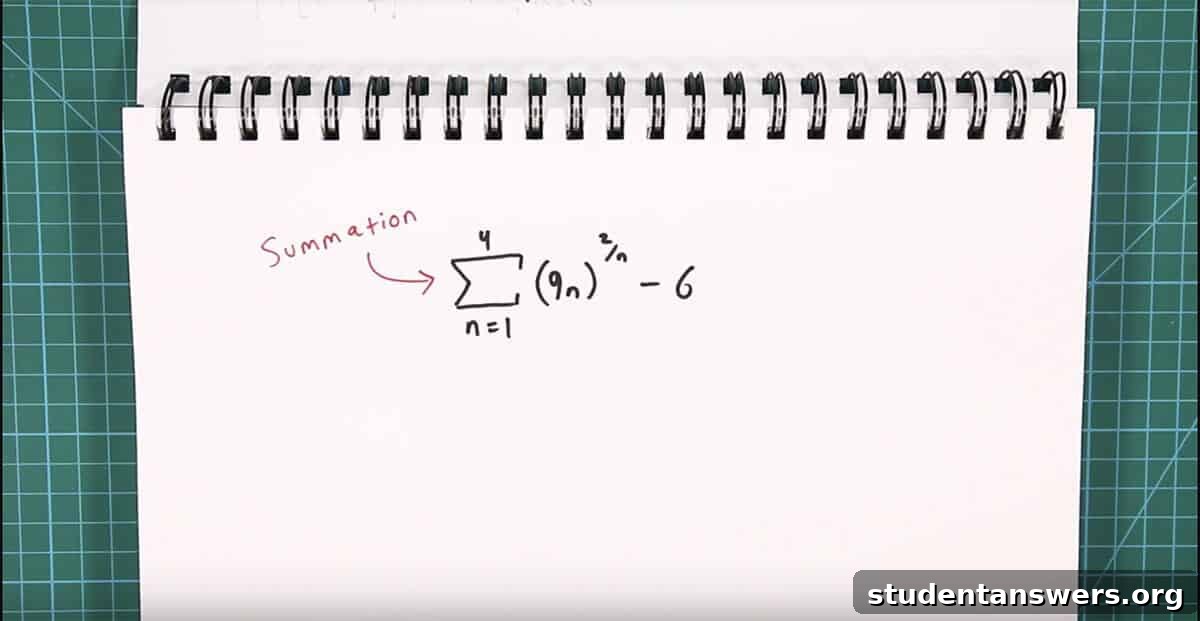
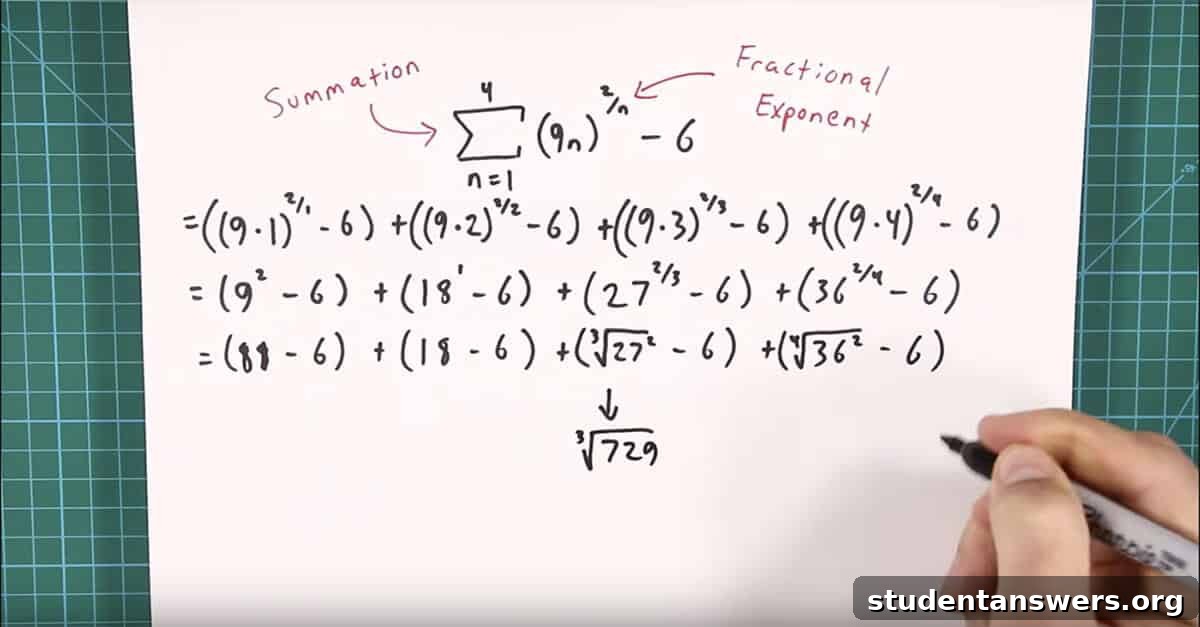
At first glance, this might seem complicated for a high school or early college student. The reason it’s tricky is that it combines two distinct mathematical ideas: summation (the Σ symbol) and fractional exponents.
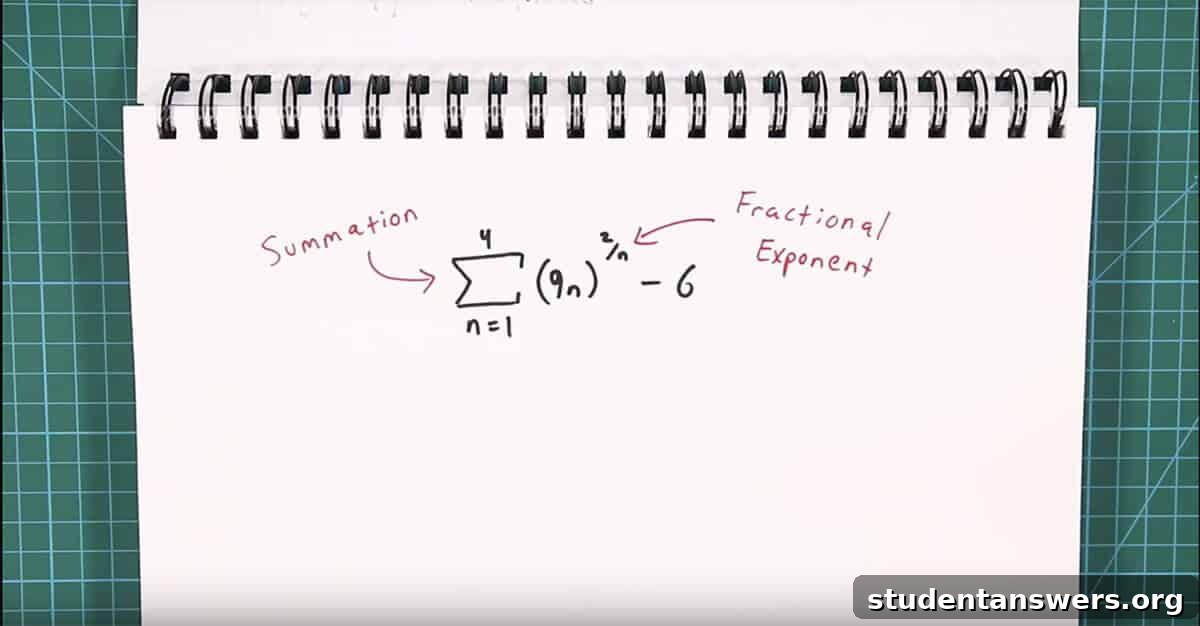
To solve this effectively, you shouldn’t try to tackle both concepts at once. Instead, deconstruct it. First, ensure you understand how summation works on its own. You could practice by temporarily removing the fractional exponent and solving that simpler version:
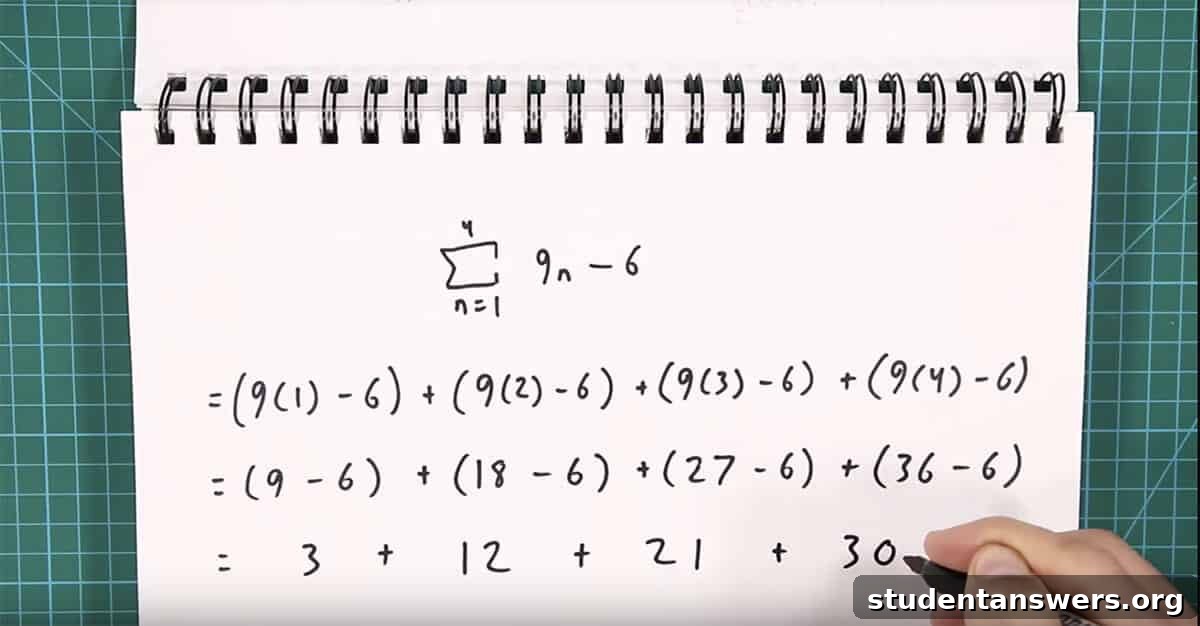
By working through the summation steps, you arrive at the first part of the solution:
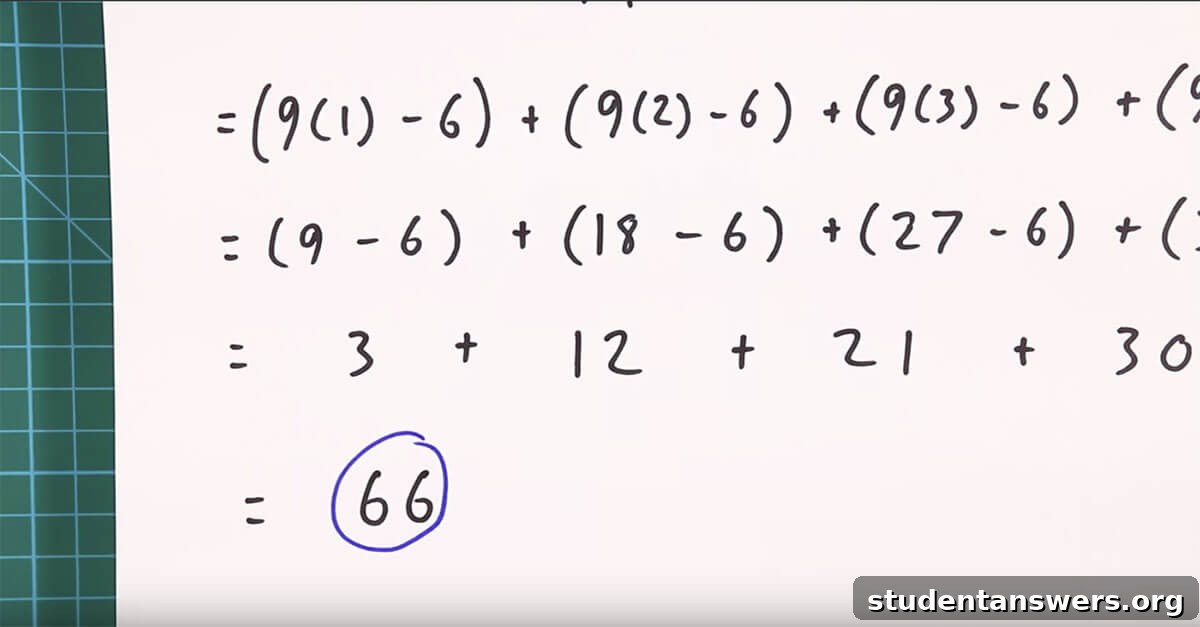
Next, isolate the second concept: the fractional exponent. Practice a few examples of this on its own to solidify your understanding. You might work on a problem like this:
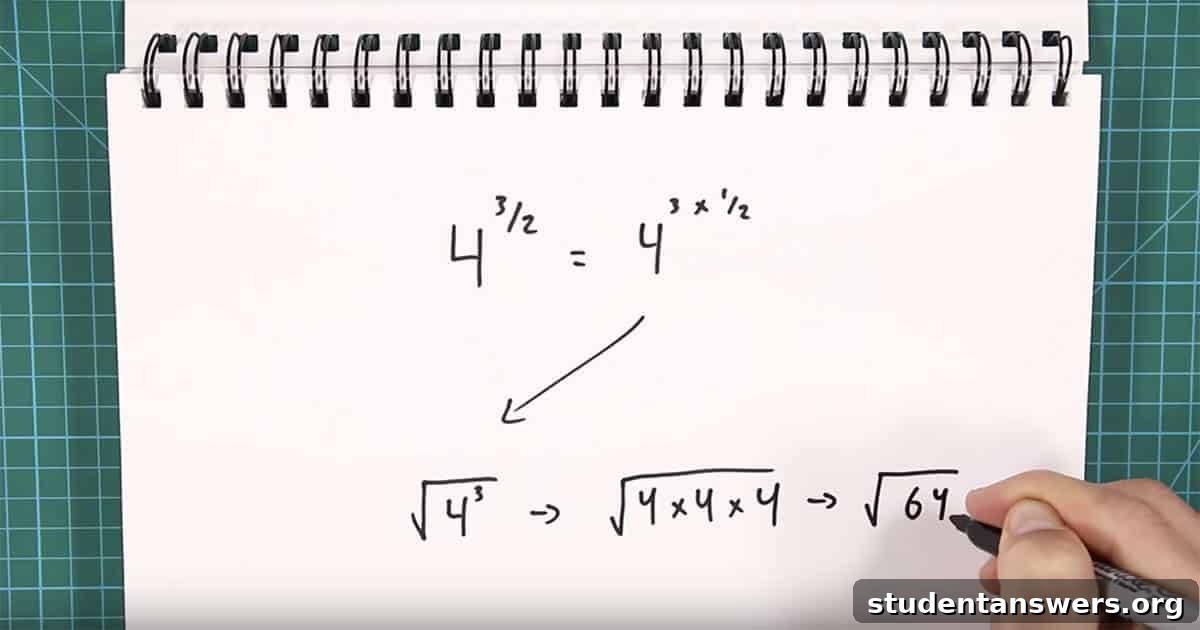
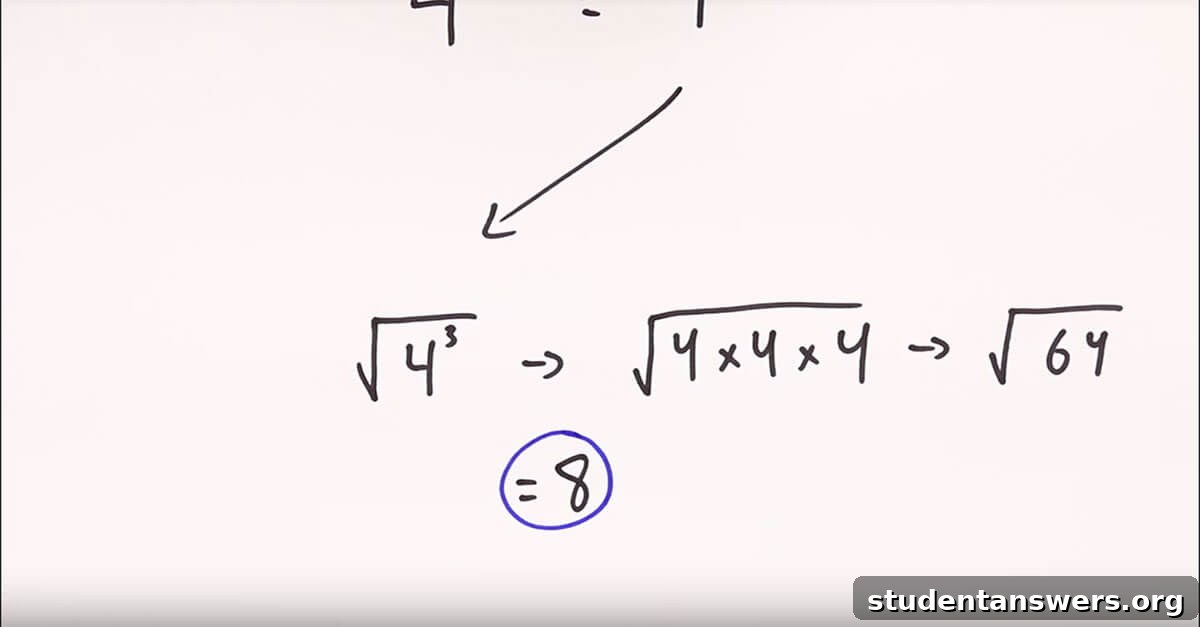
You’ll quickly realize that a fractional exponent is just another way of writing a root, and it’s not so intimidating by itself:
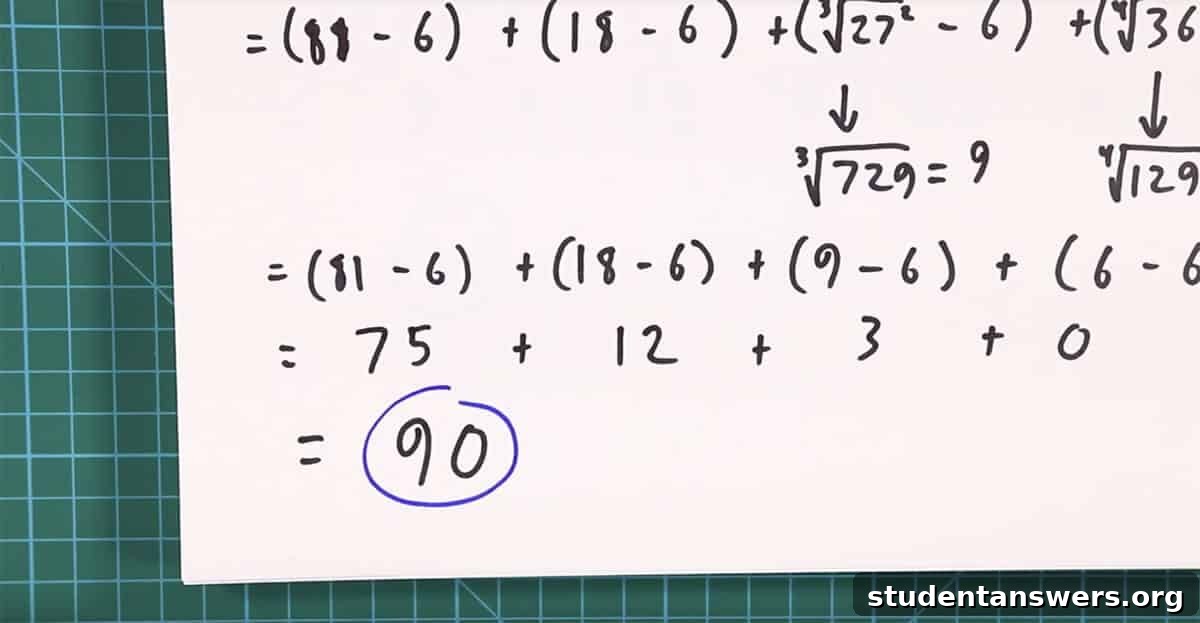
Once you are confident with both summation and fractional exponents individually, you can bring them back together to solve the original problem. The path to the solution now becomes clear and logical:
By breaking it down, you’ve conquered a complex problem and truly understood every part of it, leading you to the final, correct answer:
Tip #2: Use Simple Numbers to Isolate the Core Concept
Notice that the example problem used small, manageable numbers. This was intentional. When you’re first learning a new mathematical process or concept, the last thing you want is to be bogged down by complex arithmetic. Your brain has a limited amount of working memory, and if you’re spending it all on multiplying large numbers or dealing with messy decimals, you have less mental energy available to understand the new abstract concept.
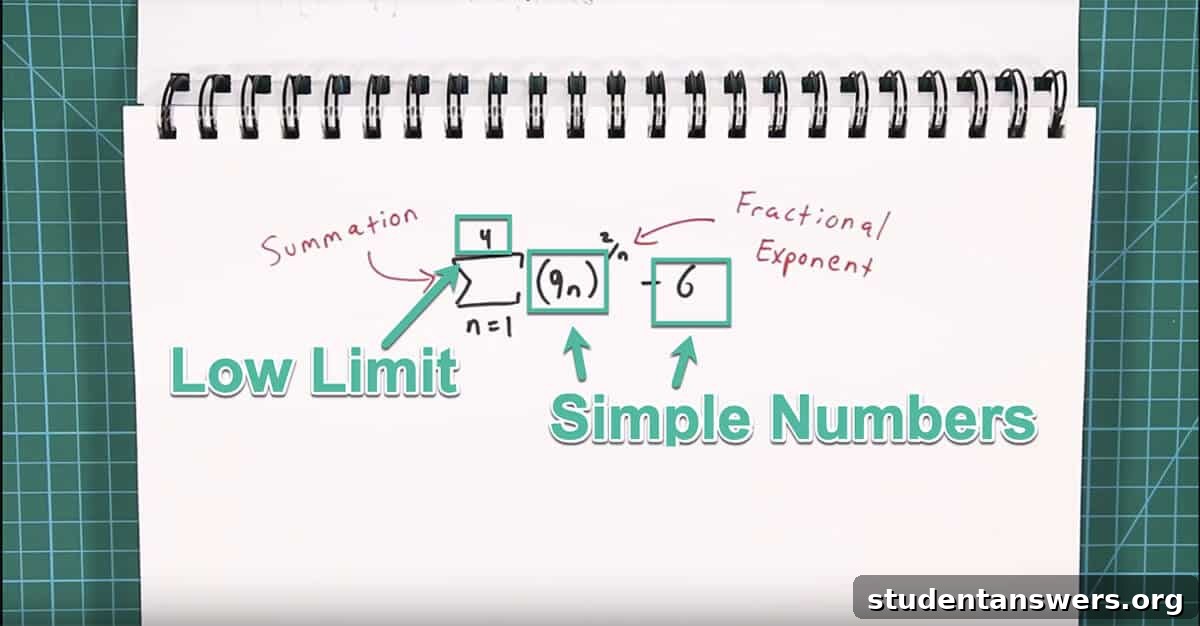
Working with problems that feature simple, whole numbers allows you to focus all your attention on the procedure and logic. The benefits are twofold:
- Reduced Cognitive Load: You don’t need a calculator, which forces you to engage more directly with the numbers and internalize the steps.
- Focus on the Process: A low limit on a summation or simple coefficients in an algebraic equation prevents you from getting tired with repetitive calculations. The goal is to learn the *how* and *why*, not to prove you can do basic arithmetic ten times in a row.
Once you’ve mastered the concept using simple numbers, you can then move on to more complex examples. This approach ensures you’re building your skills on a solid foundation.
Tip #3: Review Foundational Concepts When You’re Stuck
Let’s be realistic: much of the time, when you’re stuck on a math problem, it’s because a previous, more fundamental concept is still shaky. This is the “shaky floor” in your mathematical skyscraper, and you need to go back and reinforce it.
Your first step should be to consult your notes and textbook. Look for example problems and explanations of the underlying principles. If you’ve been taking effective notes, you’ll have a valuable resource at your fingertips. If your own notes aren’t cutting it, the internet is your friend. Websites like Khan Academy and countless YouTube channels offer detailed, step-by-step video explanations that can provide a fresh perspective.
Most importantly, leverage your human resources. As Ericsson notes, an expert teacher is invaluable because they can do more than just check your answer. A skilled math teacher “will look at exactly how the student got the answer as a way of understanding the mental representations the student was using.” They can pinpoint the exact moment your logic went astray and re-frame the concept in a way that finally clicks for you. Don’t be afraid to attend office hours or ask for help after class. This is one of the most effective ways to repair a faulty foundation.
Tip #4: Use Online Math Tools as a Tutor, Not a Crutch
In today’s digital age, powerful tools can show you step-by-step solutions to almost any math problem. While these can be incredibly helpful for learning, they can also be a dangerous crutch if used improperly. The key is to always attempt the problem yourself first.
Here are three excellent tools for getting detailed solutions:
- Wolfram Alpha: A computational knowledge engine that can solve a vast array of problems and provide detailed solutions (the premium version shows all steps).
- Symbolab: A user-friendly tool that provides free, step-by-step solutions for a wide range of math topics.
- Chegg Study: An excellent resource for finding expert solutions to specific problems in your textbook.
Simply looking at a solution creates what researchers call an “illusion of competence.” You see the logical flow and think, “Ah, I get it,” but you haven’t actually encoded that process into your own memory. To avoid this, follow a strict protocol:
- Struggle First: Push your brain to its limit trying to solve the problem on your own. This struggle is where real learning happens.
- Use the Tool Strategically: If you’re completely stuck, use the tool to get just the next step. Then, try to continue on your own.
- Analyze, Don’t Just Copy: When you view the full solution, your goal is to understand the *why* behind each step, not just the *what*.
- Re-Solve from Scratch: After understanding the solution, put it away and solve the entire problem again on a blank sheet of paper, retrieving the steps from your own memory. This is the most crucial step for building deep, lasting knowledge.
Tip #5: Don’t Rush Your Homework; Embrace Spaced Repetition
“Just understanding how a problem was solved does not necessarily create a chunk that you can easily call to mind later. Do not confuse the “aha!” of a breakthrough in understanding with solid expertise!”
– Barbara Oakley, A Mind for Numbers
In a rush to finish your homework and get back to your favorite video game or show, it’s tempting to speed through your problem sets. However, technical subjects like math demand a slower, more deliberate pace. True mastery comes from letting concepts sink in over time.
Engineering professor Barbara Oakley champions the use of spaced repetition. Instead of cramming for five hours in one night, it is far more effective to study in shorter, more frequent sessions spread out over several days or weeks. For example, you might spend one hour on a new concept on Monday, review it for 30 minutes on Wednesday, and then solve a few more complex problems related to it on Friday.
This approach gives your brain time to form and strengthen the neural connections associated with the new material. It allows you to move information from your short-term working memory into your long-term memory. Slow, consistent, and spaced-out practice helps you not only to understand a concept but also to recognize when and how to apply it in different contexts, which is the hallmark of true mathematical fluency.
Conclusion: Math is a Skill You Can Master
“I don’t believe in the idea that there are a few peculiar people capable of understanding math, and the rest of the world is normal. Math is a human discovery, and it’s no more complicated than humans can understand.”
– Richard Feynman
Getting better at math is a straightforward, though not always easy, process. It requires a shift in mindset—from believing you’re “good” or “bad” at it to understanding that it’s a skill built through consistent, intelligent effort. By applying the principles of deliberate practice, you can systematically strengthen your foundations and build your knowledge to new heights.
Remember to deconstruct complex problems, use simple numbers to master concepts, review fundamentals when you’re stuck, use online tools wisely as a learning aid, and give your brain the time it needs to absorb information through spaced repetition. Ultimately, gaining mastery in math comes down to picking up your pencil and paper and doing the hard work of solving problems yourself. The satisfaction you’ll feel when a difficult concept finally clicks into place is well worth the effort.