

How to Write a Killer College Essay: A Step-by-Step Guide for Students
Picture this common scenario: You’re in your first-year English composition class, and your professor hands out the next big assignment. It reads something like this:
“For next week, please submit a 1,000-word analytical essay on one of the poems we’ve discussed in class. The paper must be in MLA format and include at least three secondary sources. One of these sources must be a physical print book from the library.”
Your stomach drops. A thousand words feels like a novel. MLA format seems like a labyrinth of confusing rules. And a physical book? In this day and age? The assignment feels vague, overwhelming, and, if you’re a STEM major, perhaps even a bit pointless.
If this sounds familiar, you’re not alone. Many students feel a wave of anxiety when faced with a humanities essay. But it doesn’t have to be a painful process. This comprehensive guide will walk you through the initial, most crucial stages of writing a successful academic paper. We’ll break down the process into manageable steps, transforming that daunting assignment into an achievable goal. While there’s no magic formula for a perfect paper, this method has consistently helped students achieve high grades by building a strong foundation for their arguments.
We’ll use a poetry analysis as our primary example, but these principles of close reading, topic development, and research can be adapted for essays in history, philosophy, sociology, and almost any other humanities field.
Step 1: The Foundation of Analysis is Close Reading
Before you can write a single word of your essay, you need to understand your primary text on a deep level. This is where “close reading” comes in. It’s more than just letting your eyes pass over the words; it’s an active, focused engagement with the material.
To demonstrate, let’s work with a classic poem you might encounter in an introductory literature course: Emily Dickinson’s “’Hope’ is the thing with feathers –“.
“’Hope’ is the thing with feathers –“
by Emily Dickinson“Hope” is the thing with feathers –
That perches in the soul –
And sings the tune without the words –
And never stops – at all –And sweetest – in the Gale – is heard –
And sore must be the storm –
That could abash the little Bird
That kept so many warm –I’ve heard it in the chillest land –
And on the strangest Sea –
Yet – never – in Extremity,
It asked a crumb – of me.
Your Active Reading Process
The goal of close reading isn’t to find the one “right” answer. Instead, it’s to uncover layers of meaning, patterns, and questions. You’re not just reading for plot or information; you’re analyzing how the author uses language to create a specific effect.
For the best results, print out your text. This allows you to physically mark it up—underline, circle, and scribble notes in the margins. Digital tools can work, but the physical act of writing often deepens engagement. Let’s walk through a two-pass approach to analyzing Dickinson’s poem.
First Pass: Grasping the Surface Meaning
Read the poem once through without overanalyzing. What is the basic subject? Dickinson is describing “Hope” by comparing it to a bird. This bird lives in the soul, sings continuously, is resilient in storms, and asks for nothing in return, even in the hardest times. Simple enough. You now have the general idea.
Second Pass: A Deeper, Line-by-Line Dive
Now, go back with a pen in hand. Read slowly, and question everything. This is where the real analysis begins. To make it easier to reference, we’ll number the lines.
1 “Hope” is the thing with feathers –
2 That perches in the soul –
3 And sings the tune without the words –
4 And never stops – at all –5 And sweetest – in the Gale – is heard –
6 And sore must be the storm –
7 That could abash the little Bird
8 That kept so many warm –9 I’ve heard it in the chillest land –
10 And on the strangest Sea –
11 Yet – never – in Extremity,
12 It asked a crumb – of me.
Here are the kinds of questions and observations you should be making:
- Lines 1-2: Why is “Hope” in quotation marks? Is the speaker quoting a common saying, or setting the word apart as a concept? The metaphor is established: hope is a bird. Why does it “perch” in the “soul”? This suggests an internal, intimate presence.
- Lines 3-4: It “sings the tune without the words.” This is a powerful image. Hope isn’t a logical argument; it’s a feeling, a melody. The fact that it “never stops” emphasizes its persistence and resilience.
- Lines 5-6: Now we see hope in adversity. A “Gale” is a fierce storm. Why is the song “sweetest” then? This implies hope is most valuable and clear during difficult times. Why is “Gale” capitalized? It gives the storm a sense of importance, almost like a proper noun. The phrase “sore must be the storm” is interesting. A storm can’t literally be sore. This personification suggests the storm itself must be powerful and painful.
- Lines 7-8: The storm’s purpose is to “abash” (embarrass or disconcert) the “little Bird.” Notice the capitalization of “Bird.” This elevates it from a mere animal to a symbolic figure. The bird also “kept so many warm,” which is a strange thing for a small bird to do. This must be metaphorical warmth—the comfort and solace that hope provides.
- Lines 9-10: The speaker’s personal experience enters. “I’ve heard it.” The locations—”chillest land” and “strangest Sea”—are extreme and isolating. These aren’t pleasant places. Hope exists even in the most desolate and unfamiliar circumstances. Again, “Sea” is capitalized. What is the pattern here?
- Lines 11-12: The conclusion. “Extremity” is capitalized, just like Gale, Bird, and Sea. These seem to be symbolic concepts rather than literal places. The final line is key: hope is selfless. It gives its song freely and “never… asked a crumb.” It sustains the speaker without demanding anything in return.
This process of questioning is the engine of a great essay. The questions you ask now will become the problems your paper aims to solve. Also, notice the words we flagged like “abash” or “gale.” Always look up words you’re even slightly unsure about. In poetry, every word is chosen with precision.
Step 2: From Questions to a Focus – Developing a Working Thesis
You’ve filled your page with notes and questions. Now what? You need a guiding idea for your research and writing. This is your “working thesis.” It’s not your final, polished thesis statement, but rather a central topic or question that will keep you on track.
Look back over your notes. What pattern, image, or question stands out the most? For me, Dickinson’s deliberate capitalization of “Gale,” “Bird,” “Sea,” and “Extremity” is fascinating. Another strong focus is the central metaphor itself.
Let’s form a working thesis around that central metaphor:
Working Thesis: This essay will explore why Emily Dickinson uses the extended metaphor of a bird to define hope, focusing on how the bird’s characteristics—its song, its resilience, and its selflessness—illustrate the nature of hope in the human soul.
This is specific enough to guide our research. We’re no longer just writing “about the poem.” We’re investigating the function of its central literary device.
Step 3: Building Your Argument with Research
Many students view research as a tedious scavenger hunt to meet a professor’s requirements. Try to reframe this mindset. Research is a conversation. You’re entering a discussion with scholars who have spent years thinking about your topic. Their insights can strengthen your arguments, challenge your assumptions, and provide the evidence you need to move beyond simple opinion.
Starting Your Search: The University Library
Your university’s library database is the single most powerful research tool you have. It’s your gateway to credible, peer-reviewed books and academic journals—the kind of sources your professor wants to see.
Begin by navigating to your school library’s main website. You’ll find a search bar for the main catalog. Let’s start with a broad search term related to our poem, like the title: "Hope is the thing with feathers".
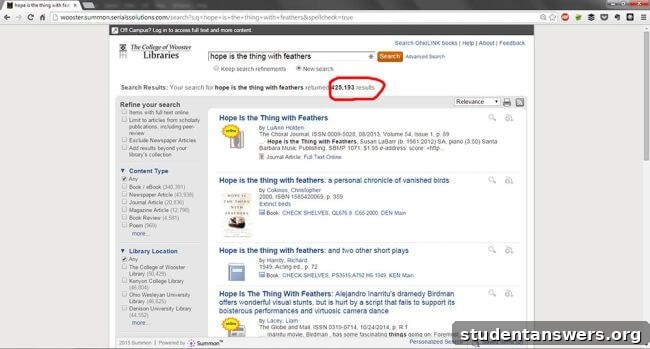
This will likely return hundreds, if not thousands, of results. Now, we use the tools on the sidebar to narrow them down.
- Filter by Format: Since the assignment requires a print book, select “Book” or “Print Book” from the format filters.
- Filter by Location: Make sure the location is set to your university’s library so you can access it quickly.
- Refine by Subject: Add subject terms like “American poetry” or “Dickinson, Emily, — Criticism and interpretation.” This will eliminate irrelevant results.
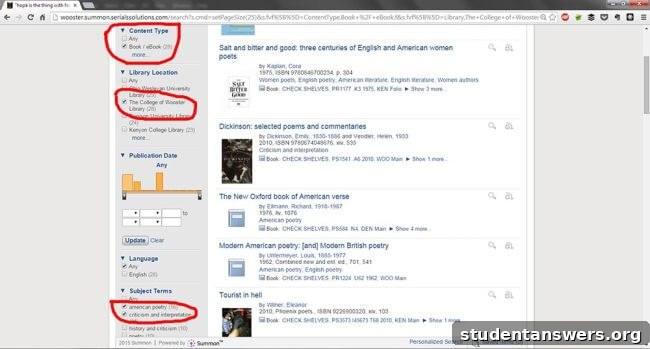
After refining, a promising title appears: Dickinson: Selected Poems and Commentaries by the renowned critic Helen Vendler. This is a perfect starting point. The next step is to locate it in the library.
A Simple Library Hack to Save Time
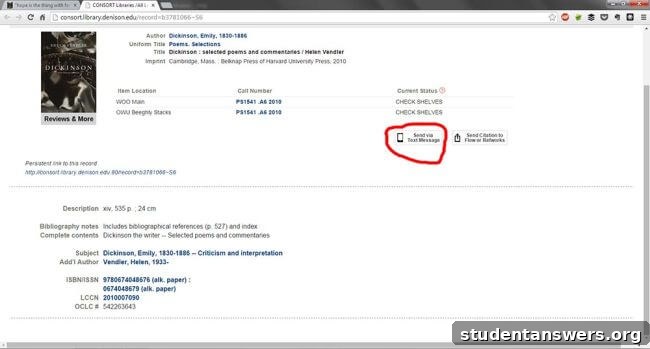
Instead of scribbling down the call number on a scrap of paper, use your phone. Most library databases have an option to “Send via Text Message” or you can simply take a clear photo of the book’s record, including the title, author, and call number. This makes finding the book on the shelves much easier.
Finding Your Remaining Sources
For your other two sources, you can look for either journal articles or other books. Go back to your refined database search, but this time, change the format filter to “Article.” A search might reveal an article in a journal called The Explicator, which specializes in close readings of literary works—an excellent fit. You might also find a reference book like Poetry for Students, which provides analysis and context for commonly studied poems.
Always skim your potential sources to ensure they are relevant to your working thesis. Do they discuss the bird metaphor? Do they offer insight into Dickinson’s use of capitalization or her views on hope? If a source isn’t helpful, set it aside and keep looking.
Step 4: The Final Preparation – Documenting Your Sources
As you find your sources, do your future self a huge favor: immediately record all the necessary citation information. Ttrying to find this information later when you’re on a deadline is incredibly stressful. Create a separate document and, for each source, write down the following:
- For a Print Book: Author(s), full title, publisher, and year of publication.
- For a Journal Article: Author(s), article title, journal name, volume number, issue number, publication year, and page numbers. If accessed online, include the database name and the URL or DOI.
- For a Website: Author (if available), page title, website name, publisher, publication date, and the date you accessed it.
Having this information ready will make creating your Works Cited page a simple, stress-free task when you finish writing.
You’re Ready to Write!
Congratulations! You have navigated the most challenging part of the essay writing process. You’ve moved from a vague, intimidating prompt to a focused topic with a solid analytical foundation and credible sources to back you up. The blank page is no longer a threat. You have a plan, you have evidence, and you have a clear direction.
The next step is to weave all of this preparation into a coherent and persuasive essay. Now you can move on to outlining, drafting, and editing your paper into a polished final product.