

How to Finish a Huge Project Overnight: Your Ultimate Survival Guide
The celebrated American author Mark Twain famously quipped, “Never put off till tomorrow what may be done the day after tomorrow just as well.” While this sentiment offers a comforting chuckle, living by it can lead to frantic, caffeine-fueled nights. We’ve all been there: staring at a monumental project due in a few short hours, chugging coffee at 2 a.m., and wondering how we let it get this far.
If this scenario feels painfully familiar—or if you’re in the middle of it right now—this guide is your lifeline. We’re not here to lecture you on the virtues of long-term planning. Instead, this is an emergency action plan, a strategic blueprint designed to help you navigate a severe time crunch and emerge victorious. We’ll dive into a practical, three-step strategy to help you focus your efforts, manage your energy, and deliver your best possible work under pressure.
Our approach is built on three core pillars: choosing the right environment to maximize focus, ruthlessly prioritizing your tasks using a powerful framework, and understanding the science of willpower to execute your plan effectively. Let’s get started.
Step 1: The Foundation – Select Your Battle Station
Before you write a single word or solve a single equation, your first critical decision is choosing where you will work. Your location is more than just a physical space; it’s an environment that can either fuel your productivity or drain your resolve. When you’re working against the clock, this choice becomes paramount.
Many people find they work best in environments with a certain “vibe”—a subtle energy that encourages focus. This is why coffee shops and university libraries are classic choices for late-night study sessions. Being surrounded by other focused, working individuals creates a sense of positive peer pressure. It’s a silent, shared commitment to productivity that can help you stay on task when your own motivation wanes. Plus, having easy access to caffeine is an undeniable advantage.
However, the single most important factor in location selection is defeating the “call of the pillow.” When you’re tired, stressed, and facing a mountain of work, the allure of your warm, comfortable bed can be overwhelming. As the night wears on, your brain will begin to rationalize. “A quick 20-minute nap will make me more productive,” it will whisper. Soon, that nap turns into an hour, and you’ll start convincing yourself that certain parts of the project aren’t really that important after all.
To combat this, you must create physical distance from your bed. Choose a location where going to sleep would require more effort than simply moving on to the next task. A desk in the living room, the kitchen table, or a 24-hour study hall are all superior options to your bedroom. Prepare your space by gathering everything you need in advance: chargers, textbooks, water, and snacks. By eliminating reasons to get up, you minimize distractions and make it easier to stay locked in.
Step 2: The Game Plan – Prioritize with the Impact/Effort Matrix
With your environment secured, it’s time to create a plan of attack. Simply diving into the work without a strategy is a recipe for disaster. You’ll waste precious time on low-value tasks and risk running out of energy before tackling what truly matters. This is where strategic prioritization comes in.
You may have heard of the Eisenhower Matrix, popularized by Stephen Covey in The 7 Habits of Highly Effective People. It categorizes tasks based on urgency and importance. However, when you’re pulling an all-nighter, everything feels urgent. A more effective tool for this specific situation is the Impact/Effort Matrix.
This framework forces you to evaluate tasks based on two simple criteria: the impact they will have on the final outcome (i.e., your grade) and the effort (i.e., time and energy) required to complete them. By plotting your project’s components onto this matrix, you gain instant clarity on what to do first, what to do later, and what to ignore completely.
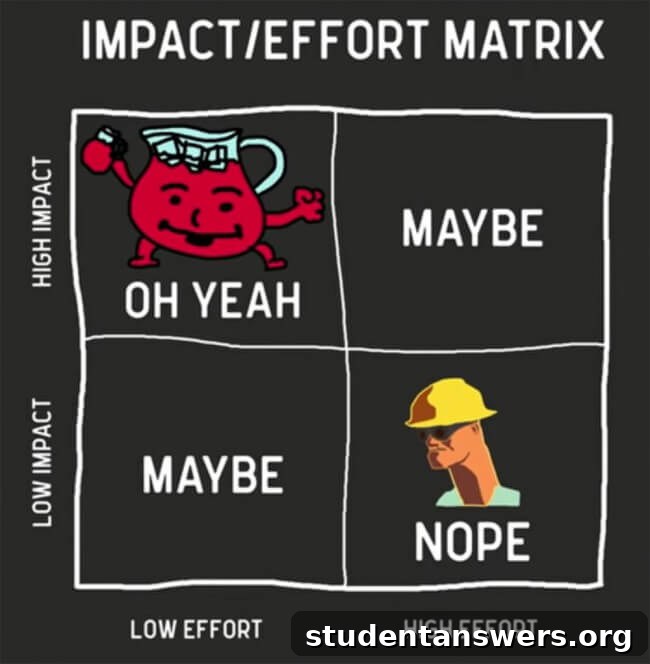
Breaking Down the Four Quadrants
- High Impact / High Effort (Major Projects): These are the cornerstones of your assignment. This quadrant includes the core deliverables that will account for the majority of your grade. For an essay, this is crafting the thesis statement and writing the body paragraphs. For a coding project, it’s developing the core functionality. These tasks are challenging, but they are non-negotiable.
- High Impact / Low Effort (Quick Wins): These are high-value tasks that can be completed relatively quickly. They are fantastic for building momentum and making your project feel more complete. Examples include creating a properly formatted title page, writing a concise introduction or conclusion, or adding clear labels to graphs and charts.
- Low Impact / High Effort (Time Sinks): These are the tasks you must avoid at all costs. They consume a disproportionate amount of time and energy for very little return. Think of overly elaborate formatting, creating custom graphics from scratch when a simple table would suffice, or spending hours on a minor detail that won’t affect your grade. In a time crunch, these are traps.
- Low Impact / Low Effort (Fill-in Tasks): These are minor tasks that add a bit of polish but aren’t critical. Examples include adding page numbers, double-checking your bibliography format, or creating a basic “About” page. These are best saved for when your mental energy is completely depleted, but you still need to be doing something.
A Case Study in Prioritization
To see this in action, consider a real-world example. During my senior year of college, I had to build a web application for a final project. I procrastinated and found myself in a serious time crunch. My app, called AMPanic, was designed to send an embarrassing email to a designated person if you didn’t log in to confirm you were awake by a certain time.
Using the Impact/Effort Matrix, I broke down the project:
- Major Projects (High Impact/High Effort): The core functionality was everything. This included the code to set an alarm, the system to schedule and send the email, and the function to cancel it upon user check-in. This was the heart of the project and where my grade would come from.
- Quick Wins (High Impact/Low Effort): I knew that having a functional, clean user interface was important for the presentation. While it wasn’t the core logic, a good UI had a high impact on the perceived quality of the project.
- Time Sinks (Low Impact/High Effort): A complete user registration system with secure password resets, email verification, and profile management would have been incredibly time-consuming. While professional, it wasn’t the point of the assignment. I decided to reuse a basic, insecure login system from a previous project and skip the password reset feature entirely.
- Fill-in Tasks (Low Impact/Low Effort): Creating simple “About” and “Contact” pages took very little time but made the website feel more complete and professional.
By focusing my energy on the core alarm functionality (High Impact) and skipping the complex user system (High Effort/Low Impact), I was able to deliver a project that excelled where it mattered most. The result was an A, because the most important part of the app was more advanced than what anyone else in the class had built.
Step 3: Flawless Execution – Master Your Willpower
Now that you have a prioritized list, the order in which you tackle it is crucial. The temptation might be to start with the easy, low-effort tasks to feel a sense of accomplishment. This is a mistake. To work most effectively, you need to understand a psychological concept known as Ego Depletion.
Popularized by psychologist Roy Baumeister and discussed in Daniel Kahneman’s book Thinking, Fast and Slow, ego depletion is the idea that self-control and willpower are finite resources. Think of your willpower like a muscle; it gets fatigued with overuse. Every decision you make throughout the day, no matter how small, depletes this resource. When your willpower is low, you are more likely to give in to distractions, make poor choices, and give up on difficult tasks.
This has profound implications for your all-nighter strategy. You must use your peak willpower—the reserve you have at the beginning of your work session—on the most demanding tasks.
Your Strategic Order of Operations:
- Start with the Major Projects (High Impact / High Effort): Dive straight into the most difficult and most important part of your project. This is when your mind is freshest and your willpower is at its highest. By conquering the biggest challenge first, you ensure the core of your work is completed to the best of your ability.
- Sprinkle in Quick Wins (High Impact / Low Effort): After making significant progress on a major task, reward yourself by knocking out a quick win. This provides a valuable psychological boost and a sense of accomplishment, which can help replenish some of your motivation to dive back into the harder work.
- Use Fill-in Tasks as Active Breaks (Low Impact / Low Effort): When you feel your brain turning to mush and you can no longer focus on complex problems, switch to these simple, mechanical tasks. It keeps you moving forward without requiring significant mental energy.
- Completely Ignore the Time Sinks (Low Impact / High Effort): Be ruthless. Do not allow yourself to get drawn into these tasks. They are the enemy of progress in a time crunch. Perfectionism must be set aside in favor of completion.
Your Blueprint for Success Under Pressure
Facing a last-minute deadline is stressful, but it doesn’t have to be a catastrophe. With a strategic approach, you can transform panic into focused, effective action. By consciously selecting an environment free from distractions, creating a clear and logical plan with the Impact/Effort Matrix, and executing that plan in an order that respects the limits of your willpower, you can accomplish more than you ever thought possible in a short amount of time.
Remember this three-step process: secure your environment, prioritize your work, and execute intelligently. Now, take a deep breath, put this plan into action, and get it done.