

Gamify Your Learning

How to Make Studying Fun: 9 Actionable Strategies to Beat Boredom
Let’s be honest for a moment: studying can often feel like a chore. For many, it’s the definition of boring. You sit down with a textbook, ready to be productive, and suddenly a million other activities seem infinitely more appealing. You might find yourself daydreaming about anything else—from adventurous hobbies to simply watching the world go by. The reality, however, is that studying is a necessary part of academic success.
This leads to a crucial question that every student has asked at some point: If I have to do it, is there at least a way to make studying fun?
The answer is a resounding yes. While you can’t transform every single study session into a thrilling adventure, you can implement powerful mindsets and practical techniques to make learning more engaging and something you might even look forward to. Today, we’ll explore proven strategies to help you conquer boredom and find joy in your studies.
But first, a quick reality check: it’s impossible to make studying fun all the time. Learning requires pushing through challenging material and embracing moments of difficulty. That’s a fundamental part of growth. However, by using the tips below, you can significantly increase how often you find your study sessions enjoyable and effective. Let’s dive in.

1. Ignite Your Curiosity and Get Interested in the Topic
More than a century ago, in the 1913 book The Freshman and His College, Francis Lockwood shared a timeless secret to making studying enjoyable:
“In the long run the secret of study resides in our ability to bathe our thought, our task, our lesson in the stream of interest.”
Interest is the fuel for learning. Before you can tackle the complex details of any subject, you need a spark of curiosity. Think about it: nobody picks up a dense academic tome on quantum physics without first being fascinated by the mysteries of the universe. You don’t read the entire history of a fantasy world before you’ve fallen in love with its main story.
The world’s greatest educators intuitively understand this principle. Bill Nye didn’t start his science shows by listing dry formulas; he showed us the wonders of electricity with exciting experiments. Sir David Attenborough captivates audiences by showcasing the dramatic hunt of a great white shark, not by delivering a lecture on the fluid dynamics of a dorsal fin. The spectacle comes first, sparking an interest that makes us want to learn the details later.
You can apply this to your own studies. Before diving into a dense history chapter, watch a compelling documentary or a historical drama about the period. If you’re studying programming, don’t just read the documentation; find a fun project you want to build, like a simple video game or a personal website. This “front-loading” of interest provides the context and motivation needed to push through the more challenging material.
For example, I could never remember the name of the 15th-century Portuguese ships—caravels. The name just wouldn’t stick. But after playing the game Civilization V, where I used caravels to explore the map and build a thriving empire, the term became permanently etched in my memory. I had connected it to an experience I found genuinely interesting and fun.
2. Adopt a Growth Mindset to Embrace Challenges
In her groundbreaking book Mindset: The New Psychology of Success, psychologist Carol Dweck identified two core mindsets through which students approach learning: the fixed mindset and the growth mindset.
Students with a fixed mindset believe that their intelligence and talents are innate, unchangeable traits. When faced with a difficult math problem, their internal monologue might be, “I’m just not a math person.” They see challenges as a verdict on their abilities.
Conversely, students with a growth mindset believe that abilities can be developed through dedication and hard work. When they encounter that same challenging problem, they think, “This is tough, but I can improve if I stick with it.” They see challenges as opportunities to grow.
Dweck’s research showed a powerful link between mindset and enjoyment. She tracked pre-med students in a notoriously difficult chemistry course designed to “weed out” candidates. Here’s what she discovered:
“Students with the fixed mindset stayed interested only when they did well right away. Those who found it difficult showed a big drop in their interest and enjoyment. If it wasn’t a testimony to their intelligence, they couldn’t enjoy it.”
The growth-mindset students, however, had a completely different experience:
“In contrast, students with the growth mindset continued to show the same high level of interest even when they found the work very challenging. Challenge and interest went hand in hand.”
The takeaway is clear: to enjoy studying, you must reframe how you view your coursework. Instead of seeing classes and exams as a series of tests that measure your inherent intelligence, view them as a training ground for your brain. Every difficult problem is a chance to get stronger. Adopting this perspective will make tackling any subject more enjoyable and far less intimidating.
3. Find a Study Partner (But Choose Wisely)
Studying with a friend can be a fantastic way to stay accountable and make learning a more social, less isolating activity. However, a study partnership can easily go wrong if you’re not careful. There are two common pitfalls:
- You become masters of procrastination together. It’s easy for a study session to devolve into chatting, watching videos, or doing anything but studying. You need a partner who is as committed to focusing as you are.
- One person does all the heavy lifting. If your study buddy is much quicker to grasp the material, you might be tempted to let them solve all the problems. This is a short-term win but a long-term loss, as you won’t actually learn the material yourself.
The key is to be selective. Find someone who is motivated and on a similar academic level. Once you’ve found your partner, establish ground rules. For instance, agree to work silently for 45-minute blocks and then take a 15-minute break to chat and review. Make a pact that you won’t move on from a problem until both of you understand the solution completely. When done right, a study partner can help you see concepts from a new perspective and make the process much more collaborative and fun.
4. Optimize and Change Your Study Environment
Your surroundings have a massive impact on your mood and ability to concentrate. Studying in a cluttered, dark, or uninspiring room is a recipe for boredom and distraction. Creating an environment that you enjoy being in is crucial for making your work feel less like a grind.

One strategy is to incorporate elements that you enjoy but that aren’t distracting. This could be a curated playlist of instrumental music, the ambient sounds of a coffee shop, or even just the quiet hum of a library. Experiment to see what works for you. Some people need absolute silence, while others focus better with a bit of background noise.
Don’t be afraid to change locations. If your desk at home feels stale, try heading to a local coffee shop, a park on a nice day, or a different floor of your campus library. A new setting can refresh your mind and break the monotony.
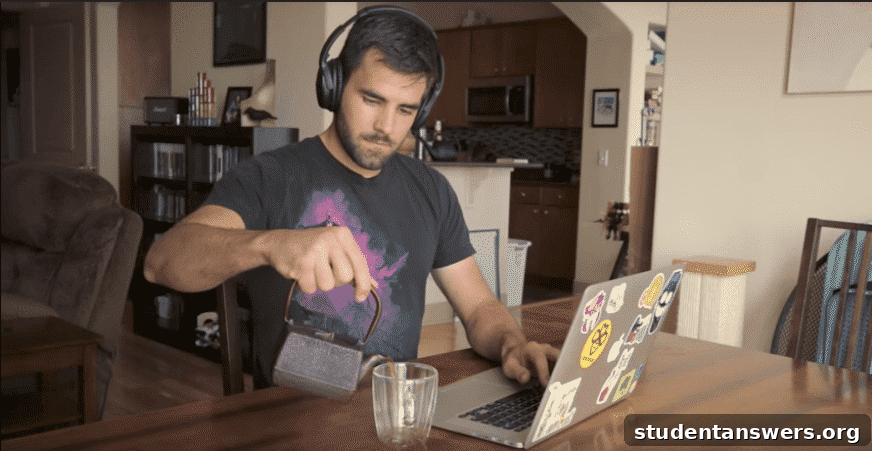
Personally, I’ve found that having a special beverage transforms my work sessions. Almost every morning, I brew a pot of my favorite cinnamon tea. The simple ritual of pouring it into a nice mug makes my writing time feel like a pleasant, cozy experience I can look forward to. This creates a positive association with the work itself.
5. Gamify Your Sessions with Pre-Planned Rewards
Your brain is wired to seek rewards. Your motivation to complete any task is directly tied to the payoff you expect to receive. While long-term rewards like a good GPA or a college degree are important, they can feel too distant to be motivating in the moment. That’s where mini-rewards come in.

These small, immediate rewards can be powerful incentives for completing assignments or studying for a set amount of time. The classic example is eating a gummy bear after reading each paragraph of a textbook. While that might work for some, the most effective rewards are what author Chris Bailey calls high-density fun. These are activities that genuinely rejuvenate you, like going for a walk, playing a video game with friends, or watching an episode of your favorite show guilt-free.
This is in stark contrast to low-density “rewards” like scrolling through social media, which often leave you feeling more drained and distracted than before.
Crucially, as noted by author Piers Steele in The Procrastination Equation, it’s important to pre-plan your rewards. Deciding your reward ahead of time builds anticipation. Knowing that a fun activity is waiting for you after you finish your work creates a powerful motivational pull, making it easier to power through the tough parts.
Conclusion: Take Control of Your Learning Experience
There are many elements of schoolwork that are outside of your control, from boring professors to mind-numbingly dry textbooks. However, you have complete control over your own mindset and approach. By cultivating genuine curiosity, adopting a growth mindset, finding the right study partners, optimizing your environment, and strategically rewarding yourself, you can transform studying from a dreaded chore into a more engaging and fulfilling activity.
What are some of your favorite tips and tricks to make studying more fun?