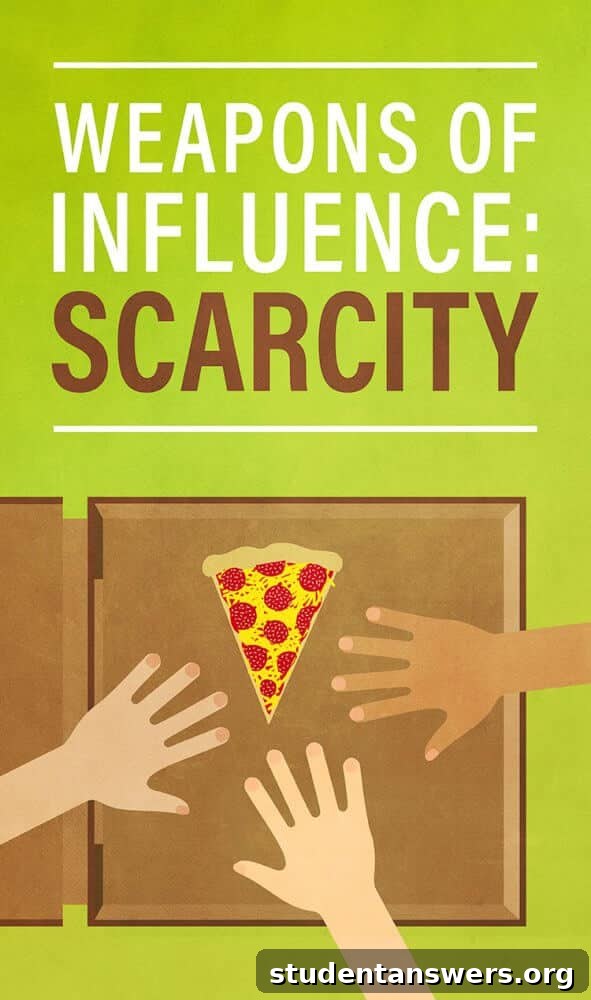

The Scarcity Principle: Cialdini’s Final Weapon of Influence
Welcome to the concluding chapter of our deep dive into Dr. Robert Cialdini’s groundbreaking book, “Influence: The Psychology of Persuasion.” Over the past five articles, we’ve explored the subtle yet powerful forces of Reciprocation, Commitment and Consistency, Social Proof, Liking, and Authority. Now, we arrive at the sixth and perhaps most potent principle of them all: Scarcity.
The scarcity principle states that we, as humans, place a higher value on objects and opportunities that we perceive as being rare or less available. The fear of missing out (FOMO) is not just a modern social media phenomenon; it’s a deeply ingrained psychological trigger that has driven human behavior for millennia. When something is limited, our desire for it skyrockets. This very principle is what makes us crave limited-edition products, rush to “one-day-only” sales, and even assign immense value to things like gold and diamonds.
In this comprehensive guide, we’ll dissect the scarcity principle, explore its powerful partnership with loss aversion, understand the rebellious nature of psychological reactance, and ultimately, learn how to defend ourselves against its manipulative use. Prepare to uncover why the threat of “you can’t have it” is one of the most persuasive messages you’ll ever hear.
What is the Scarcity Principle? The Psychology of “Get It Before It’s Gone”
At its core, the scarcity principle operates on a simple mental shortcut, or heuristic: if something is rare or difficult to obtain, it must be valuable. This shortcut saves us time and mental energy. Instead of conducting a thorough analysis of an item’s worth, our brains default to the assumption that its limited availability is a direct indicator of its quality and desirability. Marketers and salespeople have mastered the art of leveraging this cognitive bias.
Consider these common tactics:
- Limited Number: Phrases like “Only 3 left in stock!” or “Limited edition of 500 copies” create a sense of competition. Suddenly, you’re not just evaluating the product; you’re competing with other potential buyers for a scarce resource. This pressure can cloud judgment and lead to impulsive decisions.
- Limited Time: The “flash sale” or “offer ends at midnight” tactic creates a sense of urgency. The opportunity to acquire the item at a specific price is the scarce resource. The pressure is on to act now, or lose the chance forever.
The effectiveness of these tactics is amplified because we hate to lose our freedoms. As opportunities become less available, we lose the freedom to choose them. This loss of freedom is something we instinctively fight against, a concept Cialdini explores further with psychological reactance.
The Double Threat: How Scarcity and Loss Aversion Work Together
The power of scarcity is significantly magnified when combined with another powerful cognitive bias: loss aversion. Coined by psychologists Daniel Kahneman and Amos Tversky, loss aversion describes our tendency to feel the pain of a loss approximately twice as powerfully as the pleasure of an equivalent gain. In simple terms, losing $50 feels much worse than finding $50 feels good.
How does this relate to scarcity? When an item is presented as scarce, the primary motivator often shifts from the pleasure of *gaining* the item to the pain of *losing the opportunity* to have it. The focus is no longer on what you will get, but on what you will miss out on. The thought of the door closing on a great deal triggers our powerful aversion to loss, compelling us to act quickly to avoid that negative feeling.
Think about a real estate agent telling you that another couple is “very interested” in the house you’re considering. Immediately, your perspective shifts. It’s no longer just about acquiring a new home; it’s about not losing *this specific home* to someone else. The scarcity of the opportunity, combined with the fear of loss, creates a potent and often irresistible cocktail of persuasion.
Psychological Reactance: The Inner Rebel That Wants What It Can’t Have
Have you ever noticed that as soon as something is forbidden, it becomes infinitely more appealing? This phenomenon is known as psychological reactance. It’s an emotional reaction to rules, regulations, or attempts at persuasion that threaten our sense of freedom. When we feel our ability to choose is being limited, we don’t just desire the forbidden item more; we actively resist the person or system imposing the limitation.
This is often called the “Romeo and Juliet effect.” The more their families tried to keep them apart, the more determined they were to be together. Banning a book almost guarantees a spike in its sales. Parental advisory labels on music have been known to increase an album’s allure to teenagers.
A fascinating modern example of psychological reactance is the Streisand effect. In 2003, entertainer Barbra Streisand sued a photographer to have an aerial photograph of her Malibu home removed from a public collection of coastal images. Before the lawsuit, the image had been viewed only a handful of times. After the news of her attempt to suppress it broke, millions of people flocked online to see the photo. Her attempt to restrict access made the information exponentially more desirable, demonstrating reactance on a massive scale.
Scarcity in Action: Real-World Examples and Tactics
Scarcity is not just a theoretical concept; it’s a practical tool used in countless scenarios. Understanding how it’s deployed can help you recognize it in your own life.
The “Once-in-a-Lifetime” Offer
Some of the most powerful scarcity tactics create an opportunity that is not just limited, but entirely unique. A striking example is the Future Library project in Norway. Each year from 2014 to 2114, a famous author (including authors like David Mitchell) is commissioned to write a manuscript. These manuscripts are then locked away, unpublished and unread, in a specially designed room in a public library until the year 2114. The scarcity here is absolute; no one alive today will ever get to read these works. This ultimate limitation creates an almost mythical value and an intense public fascination.
The Collector’s Market
The value of collectibles, from vintage comic books to trading cards, is almost entirely driven by scarcity. Consider the “Black Lotus” card from the game Magic: The Gathering. Functionally, it’s a piece of cardboard. However, due to its power in the game and extremely limited print run from the game’s first set, a pristine copy can sell for hundreds of thousands of dollars. The value isn’t in the material, but in its profound rarity.
Exclusive Access and Information
Scarcity doesn’t just apply to physical goods. Exclusive information can be just as, if not more, valuable. When a company insider gives a “hot tip” on a stock, the information’s perceived value is tied directly to its exclusivity. We tend to believe that restricted information is more truthful and insightful than publicly available information. This is why “members-only” deals and “insider access” are such effective marketing tools.
How to Resist the Powerful Pull of Scarcity
Now that you understand the mechanics of scarcity, how can you defend yourself against its manipulative use? The key is to shift from an emotional, reactive state to a calm, analytical one.
- Recognize the Emotional Rush: The first step is awareness. When you feel a wave of panic, urgency, or competitive arousal while considering a purchase, stop. Acknowledge the feeling. That visceral response is the scarcity principle hijacking your decision-making process. Take a deep breath and pause before acting.
- Separate Want from Utility: Ask yourself a critical question: “Why do I want this?” Is it because of its function, what it does for you, and how it will improve your life? Or is it primarily because it’s rare, on sale for a limited time, or because someone else might get it first? The goal is to separate the item’s utility from the artificial value created by its scarcity.
- Analyze the Source of Scarcity: Is the scarcity genuine or manufactured? A one-of-a-kind piece of art has genuine scarcity. A “limited edition” sofa from a mass-market retailer often has artificial scarcity, created purely as a sales tactic. Understanding this distinction can diffuse the item’s perceived value.
Remember, the joy of owning something comes from using it and experiencing it, not just from the act of acquiring it. If you wouldn’t want the item as much if it were plentiful and readily available, then you’re likely being influenced by scarcity, not by genuine need or desire.
Mastering the Final Weapon of Influence
The principle of scarcity is a formidable force in human psychology. It preys on our fear of loss and our innate desire for freedom, creating a potent urgency that can override rational thought. By understanding that our desire for a limited item is often a reaction to its unavailability rather than a reflection of its true worth, we can regain control.
As we conclude this series on Cialdini’s six weapons of influence, the overarching lesson is one of awareness. By recognizing the psychological triggers of Reciprocation, Commitment, Social Proof, Liking, Authority, and Scarcity, we can become more discerning consumers, more effective communicators, and more thoughtful individuals. We can choose to use these principles ethically to create positive change and, just as importantly, defend ourselves when they are used to manipulate us.
Further Reading and Resources:
To deepen your understanding of these powerful psychological principles, explore the original source and related materials from our series:
- Influence: The Psychology of Persuasion, by Robert Cialdini
- Weapons of Influence #1: Reciprocation
- Weapons of Influence #2: Commitment and Consistency
- Weapons of Influence #3: Social Proof
- Weapons of Influence #4: Liking
- Weapons of Influence #5: Authority
- Psychological reactance
- Cloud Atlas, by David Mitchell
- Streisand effect
Want more cool stuff? You can find all sorts of great tools at my Resources page.