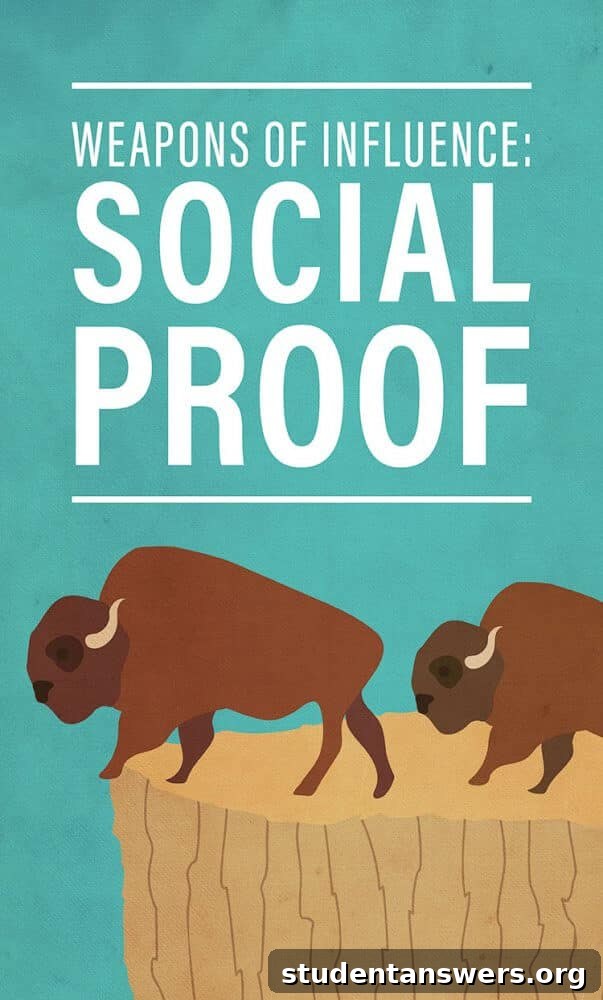
İknanın Gizli Silahı Sosyal Kanıt

The Power of Social Proof: Cialdini’s Weapon of Influence Explained
Have you ever chosen a restaurant simply because it was bustling with people, while the one next door was empty? Or have you found yourself more inclined to buy a product after seeing hundreds of positive reviews online? If so, you’ve experienced one of the most powerful psychological triggers in human behavior: social proof. This concept, masterfully explored in Robert Cialdini’s seminal book, Influence: The Psychology of Persuasion, is a mental shortcut we all use to navigate our complex world. It’s the “wisdom of the crowd” in action, but like any powerful tool, it can be used for good or for manipulation.
At its core, the principle of social proof states that we determine what is correct by finding out what other people think is correct. When we are uncertain about how to act, we look to the behavior of others to guide our own. This is usually a highly efficient and reliable way to make decisions. After all, if thousands of people are listening to a podcast, watching a show, or buying a product, it must be good, right? While this heuristic often serves us well, it can also lead us astray, sometimes with devastating consequences. This article will delve deep into the mechanics of social proof, exploring how it works, when it’s most potent, and how you can both leverage its power for positive change and defend yourself against its manipulative use.
What Exactly Is Social Proof? A Guide to Following the Herd
Social proof is the idea that people will conform to the actions of others under the assumption that those actions are the correct behavior. It’s a form of social influence where we copy the actions of others in an attempt to emulate behavior in certain situations. Think of it as a natural survival instinct. In a prehistoric world, if you saw your entire tribe suddenly run from a bush, you wouldn’t stop to investigate; you’d run first and ask questions later. Following the group often meant survival.
In the modern world, this instinct manifests in countless ways:
- Laugh Tracks: TV producers have long known that canned laughter makes audiences perceive a show as funnier. Even if we consciously know the laughter isn’t real, our brains are wired to respond to the social cue that “others are finding this amusing.”
- Online Reviews and Ratings: Platforms like Amazon, Yelp, and TripAdvisor are built on social proof. A product with 4.5 stars from 3,000 reviews feels infinitely safer than a product with no reviews at all.
- “Bestseller” Labels: When a book is labeled a “New York Times Bestseller,” it instantly gains credibility. We assume that if millions of people have read it, it must be worth our time.
- Social Media Metrics: The number of likes, shares, and followers a person or brand has serves as a powerful indicator of their importance and authority. A video with millions of views is more likely to be clicked on than one with a few hundred.
This principle works because it saves us mental energy. We don’t have time to research every single decision we make. By relying on the “proof” of the crowd, we can make quick, and often good enough, decisions without exhaustive analysis. The problem arises when this autopilot mode is exploited or when the crowd is fundamentally wrong.
The Two Conditions That Supercharge Social Proof
According to Robert Cialdini, social proof isn’t equally powerful in all situations. Its influence is dramatically amplified under two specific conditions: uncertainty and similarity.
1. Uncertainty
When we are unsure of ourselves, when the situation is ambiguous or new, we are most likely to look to and accept the actions of others as correct. Imagine your first day at a new office. You’re not sure about the dress code, when to take lunch, or the general office etiquette. What do you do? You observe your colleagues. Their behavior becomes your guide. In situations of high uncertainty, our reliance on social cues skyrockets because we lack an internal compass for how to act.
This is why social proof is a cornerstone of marketing for new and innovative products. Consumers are uncertain about the product’s value, so marketers flood them with testimonials, case studies, and user statistics to provide the necessary social cues that the product is a safe and correct choice.
2. Similarity
We are most influenced by the actions of people we perceive as being similar to ourselves. The proof of one’s peers is more persuasive than that of a dissimilar crowd. This is why a testimonial from an “ordinary mom” can be more effective at selling a household product than a celebrity endorsement. Viewers see someone like them and think, “If it works for her, it will probably work for me too.”
Advertisers masterfully leverage this principle. They create ads featuring people who mirror their target demographic—whether it’s college students, retirees, or young professionals. By seeing people “just like us” using a product or service, the message becomes far more resonant and persuasive. This is also why we are more likely to take a recommendation from a friend with similar tastes than from a random critic.
The Dark Side: When Social Proof Leads Us Astray
While social proof is often a helpful guide, its automatic and unconscious nature makes us vulnerable to manipulation and grave errors in judgment. Two of the most well-documented negative outcomes are the bystander effect and pluralistic ignorance.
Pluralistic Ignorance and the Bystander Effect
The bystander effect is a chilling social phenomenon where individuals are less likely to offer help to a victim when other people are present. The greater the number of bystanders, the less likely it is that any one of them will help. This is often driven by a psychological state known as pluralistic ignorance.
Pluralistic ignorance occurs when a majority of group members privately reject a norm but incorrectly assume that most others accept it, and therefore go along with it. In an emergency, everyone might be deeply concerned but, seeing that no one else is reacting, they assume the situation isn’t actually an emergency. Each person’s inaction reinforces the group’s collective inaction, creating a dangerous feedback loop.
To overcome the bystander effect in an emergency, the key is to be direct and remove uncertainty. Instead of shouting, “Someone call for help!” which diffuses responsibility, you should single someone out: “You in the red jacket, call 911 immediately!” This breaks the spell of pluralistic ignorance and assigns clear responsibility, dramatically increasing the chances of receiving aid.
Manipulation and Deception
Where there is a powerful psychological trigger, there are those who will exploit it. In the digital age, social proof can be easily faked. Businesses can buy fake followers, pay for glowing reviews, or use bots to create the illusion of popularity. This “astroturfing”—creating a false sense of grassroots support—can trick consumers into believing a product, service, or idea is more popular and credible than it actually is. This is why developing a healthy skepticism and looking for authentic signals, rather than just raw numbers, is a crucial skill for modern consumers.
Case Study: The Ultimate Price of Following the Crowd
Perhaps the most horrifying example of social proof gone wrong is the 1978 Jonestown massacre. Over 900 members of the Peoples Temple cult, led by Jim Jones, died in a mass murder-suicide in a remote settlement in Guyana. How could such a large group of people willingly participate in their own destruction?
Social proof was a critical factor. The followers were in a completely new and uncertain environment, cut off from the outside world. Their only source of information and guidance was Jim Jones and their fellow cult members. This extreme uncertainty made them highly susceptible to social cues. Furthermore, the principle of similarity was at its peak; they saw themselves as a unified family of believers. When a few devoted followers complied with the order to drink the cyanide-laced beverage, their actions provided powerful, tragic proof for others to follow suit. In this isolated, high-pressure environment, the instinct to conform overwhelmed the instinct for survival.
How to Use Social Proof for Good and Defend Against It
Understanding social proof allows you to both harness its power and protect yourself from its negative influence.
To Harness Its Power: If you want to build better habits, surround yourself with people who already embody them. Join a running club to become a runner. Participate in a study group to improve your grades. Immerse yourself in a community of people who are doing what you want to do. By doing so, you create positive social proof that makes the desired behavior feel like the normal, correct thing to do.
To Defend Against It:
- Be Aware: The first step is to simply recognize when social proof is influencing your decisions. Are you buying this because you’ve researched it, or because it’s popular?
- Question the Crowd: Don’t blindly trust the herd. Is the crowd’s information reliable? Do they have expertise, or are they just following each other? Are the online reviews from verified purchasers or anonymous bots?
- Seek Objective Evidence: Look beyond popularity metrics. Examine the facts. Read critical reviews, not just glowing ones. Test a product yourself if you can. Make decisions based on data and your own judgment, not just social consensus.
- Turn Off Autopilot: For important decisions, consciously disengage the mental shortcut of social proof. Take a moment to think independently and ensure your choice aligns with your own values and goals, not just the perceived norms of the group around you.
Conclusion: Navigating the Tides of Influence
Social proof is an undeniable and deeply ingrained part of our psychological makeup. It is a double-edged sword that helps us navigate countless daily decisions with ease but also leaves us vulnerable to manipulation and herd mentality. As Robert Cialdini so brilliantly illustrates, it is one of the most effective “weapons of influence.” By understanding its mechanics—especially the amplifying effects of uncertainty and similarity—we can become more conscious consumers, more critical thinkers, and more effective leaders. The goal isn’t to reject the wisdom of the crowd entirely, but to learn when to listen to it and, more importantly, when to trust our own judgment and forge our own path.