

Reclaiming Your Attention in a Distracted World
Embracing Digital Minimalism: A Guide to Reclaiming Your Focus in a Distracted World
Chances are, you’re reading this on your smartphone. There’s nothing inherently wrong with that; it’s the gateway to the world’s information, after all. But take a moment to reflect. Since you unlocked your screen to get here, what else did you do? Did your thumb automatically drift towards the familiar icon of Instagram, Twitter, or TikTok for a “quick check”?
For most of us, these small detours are a daily, even hourly, reality. A quick glance at a notification turns into a twenty-minute scroll through an endless feed. These seemingly harmless stops accumulate, chipping away at our time, focus, and mental clarity. We find ourselves living in a state of semi-distraction, our attention fractured by a constant barrage of alerts, messages, and algorithmically-curated content.
But what if there was a better way? What if we could redefine our relationship with technology, transforming it from a source of distraction into a tool for intentional living? This is the core premise of Cal Newport’s influential book, Digital Minimalism. Today, we’ll dive deep into this philosophy to build a practical framework for shifting your life away from the tyranny of the notification badge and towards something more meaningful and fulfilling.
What Exactly Is Digital Minimalism?
When people hear the term “minimalism,” they often picture stark white rooms or owning less than a hundred possessions. Digital minimalism isn’t about Luddism or abandoning technology altogether. It’s not a call to throw your iPhone into a river and live in a cabin (though the occasional cabin retreat is a great idea).
Instead, Cal Newport defines digital minimalism as:
A philosophy of technology use in which you focus your online time on a small number of carefully selected and optimized activities that strongly support things you value, and then happily miss out on everything else.
The key words here are value and intention. A digital minimalist doesn’t reject technology but questions its role. Instead of passively accepting every new app, platform, and gadget that comes along, they ask critical questions:
- Does this tool genuinely support something I deeply value, like my career, my relationships, or my hobbies?
- Is this the best way to use technology to support that value?
- How can I use this tool in a way that maximizes its benefits and minimizes its harms?
This approach flips the script. Instead of letting technology dictate how we spend our time and attention, we take control and use it to serve our goals deliberately.
The Problem: Why We Need Digital Minimalism Now More Than Ever
Our current struggle with digital distraction is not a result of personal failure or a lack of willpower. It’s the consequence of a deliberate and incredibly sophisticated system known as the “attention economy.” Companies behind the most popular apps and platforms profit directly from your attention. The more time you spend on their service, the more ads you see, and the more data they collect.
To capture and hold your attention, these services are engineered to be addictive, using principles from behavioral psychology:
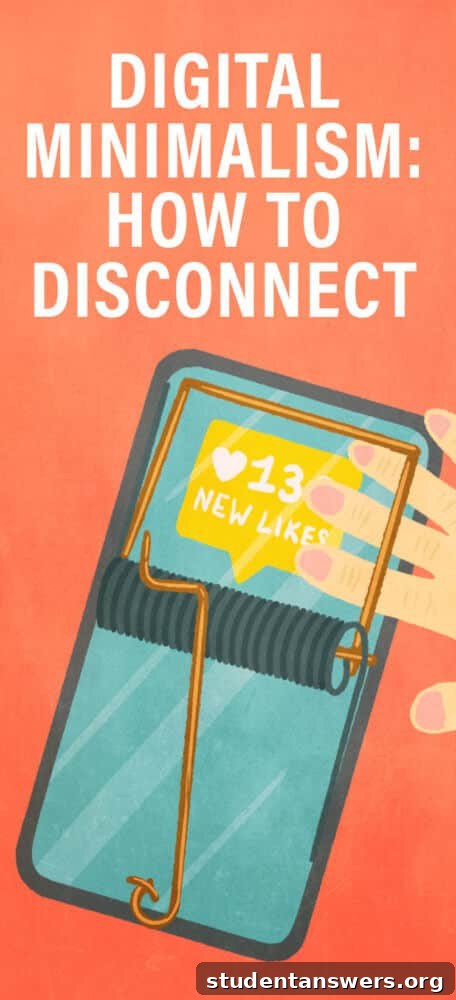
- Intermittent Positive Reinforcement: The unpredictable nature of “likes,” comments, and new posts creates a dopamine loop similar to a slot machine. You keep pulling the lever (refreshing the feed) in hopes of a reward.
- Social Approval Indicators: Features like friend counts, follower numbers, and likes tap into our fundamental human need for social validation, making us crave digital affirmation.
- Fear of Missing Out (FOMO): Endless feeds and 24-hour stories create a sense of urgency, making you feel that if you’re not constantly checking in, you’re falling behind or being left out.
This constant, low-grade distraction has profound consequences. It erodes our ability to engage in “deep work”—the focused, uninterrupted concentration required to learn complex skills and produce high-quality work. It also replaces rich, real-world interactions with shallow, low-bandwidth connections, leaving us feeling lonelier than ever despite being more “connected.”
The Solution: Cal Newport’s 30-Day Digital Declutter
To break free, Newport proposes a radical but effective method: the digital declutter. This isn’t just about deleting a few apps; it’s a complete reset of your digital life. The process involves three key steps.
Step 1: Define Your Technology Rules (The 30-Day Break)
For a period of 30 days, you take a step back from all “optional” technologies in your personal life. This is the most challenging but most crucial part of the process.
First, you must define what “optional” means for you. Technologies that are essential for your work or critical for family logistics might be exempt, but with strict rules. For everything else—social media networks, news feeds, online games, streaming services you use for background noise—you take a complete break.
The purpose of this break is not to prove you can live without these things forever. It’s to create a clean slate, breaking the addictive cycles and giving your mind the space it needs to rediscover what truly matters.
Step 2: Explore and Rediscover High-Quality Activities
Simply removing distractions isn’t enough. The void left by constant connectivity can be unsettling. You must fill that time with intentional, high-quality activities. During your 30-day break, the goal is to reconnect with the analog world.
This could mean:
- Starting a new hobby or revisiting an old one (e.g., painting, learning an instrument, woodworking).
- Scheduling regular face-to-face meetups with friends instead of just texting.
- Reading physical books that have been gathering dust on your shelf.
- Spending time in nature without your phone.
- Learning to be comfortable with solitude, just sitting with your own thoughts without digital stimulation.
This phase is about discovering what brings you genuine satisfaction and joy, rather than the fleeting pleasure of a notification.
Step 3: Reintroduce Technology with Intention
At the end of the 30 days, you don’t simply go back to your old habits. You evaluate each optional technology one by one, acting as a strict gatekeeper. For each tool you consider reintroducing, you must ask:
- Does this technology directly support something I deeply value? Be specific. “Connecting with friends” is too vague. “Organizing my weekly hiking group” is a concrete value.
- Is this technology the best way to support that value? Could you achieve the same goal with a less intrusive tool or an analog method?
- How will I constrain my use of this technology to maximize its value and minimize its harm? This involves setting clear rules. For example, “I will only use Instagram on my desktop computer for 30 minutes on Saturday morning to check in with my artist friends” instead of having it on your phone 24/7.
If a technology doesn’t pass this rigorous test, it doesn’t make it back into your life. You’ll find that many of the tools you thought were essential are actually just sources of clutter.
Practical Strategies for a Digitally Minimal Life
Beyond the declutter, adopting a minimalist mindset involves building sustainable habits that protect your time and attention.
Embrace Solitude
Newport argues that we have lost the ability to be alone with our thoughts. The moment boredom strikes, we reach for our phones. Yet, solitude is where new ideas are born, problems are solved, and a sense of self is solidified. Practice leaving your phone behind when you go for a walk. Dedicate specific times to simply think, without any external input.
Reclaim Leisure
Shift from passive consumption (scrolling, binge-watching) to active creation and engagement. Join a local sports league, take a cooking class, or volunteer for a cause you care about. These activities provide a deeper, more lasting sense of fulfillment than any number of likes on a post. Prioritize demanding, hands-on hobbies that require real-world skill and effort.
Prioritize High-Bandwidth Conversation
Likes, comments, and DMs are low-bandwidth forms of communication. They lack the nuance of tone and body language that builds strong relationships. Make a conscious effort to replace texting with phone calls or, even better, in-person conversations. Schedule “conversation office hours” where you let friends and family know they can call you, ensuring you’re fully present and ready to connect.
Conclusion: A More Intentional Life Awaits
Digital minimalism is not about deprivation; it’s about liberation. It’s about consciously choosing a life of depth and intention over a life of constant, shallow distraction. By carefully curating the tools you allow into your life, you reclaim your most valuable resources: your time and your focus. You create space for creativity, meaningful relationships, and the pursuit of what truly matters. The path isn’t easy, but the reward—a more present, focused, and fulfilling life—is well worth the effort.
Helpful Resources
If you’re ready to explore these ideas further, here are some excellent starting points:
- Digital Minimalism: Choosing a Focused Life in a Noisy World, by Cal Newport
- Deep Work: Rules for Focused Success in a Distracted World, by Cal Newport
- How to Break up with Your Phone, by Catherine Price
- Our podcast episode on Deep Work, where we discuss how to focus and resist distractions.