

The GPA Turnaround Plan for This Semester

How to Raise Your GPA: A Strategic Guide for College Success
You’re staring at your mid-term grades, and a familiar sense of dread creeps in. The organic chemistry workload is overwhelming, your weekly French quizzes are a struggle, and your part-time job is draining your study time. Your GPA is slipping, putting your scholarships and even your desired major at risk. It’s a classic college nightmare, and it’s easy to feel trapped in a cycle of stress and frustration.
When your academic standing is on the line, the pressure can be immense. But take a deep breath. A low GPA is not a final verdict; it’s a signal that your current approach needs adjustment. You have the power to turn things around, and it starts with a clear, actionable plan. This comprehensive guide will walk you through the essential strategies to not only rescue your GPA this semester but also build habits for long-term academic excellence.
How to Calculate Your GPA: The First Step to Improvement
Before you can improve your Grade Point Average (GPA), you need to understand exactly how it works. While the concept seems simple, the specific calculations can vary between universities. This guide focuses on the standard 4.0 scale used by most colleges and universities in the United States.
The fundamental formula for calculating your semester GPA is straightforward:
Total Grade Points Earned / Total Credit Hours Attempted
Let’s break down each component of this formula so you can see how every grade impacts your overall standing.
Understanding Grade Points
Most colleges use letter grades (A, B, C, etc.) for individual courses. To calculate your GPA, these letters must be converted into their numerical equivalents on the 4.0 scale. This conversion is what we call “grade points.”
A typical conversion chart looks like this:
- A = 4.0
- A- = 3.7
- B+ = 3.3
- B = 3.0
- B- = 2.7
- C+ = 2.3
- C = 2.0
- C- = 1.7
- D = 1.0
- F = 0.0
It’s crucial to check your specific university’s policy, as some institutions use slightly different values. You can usually find a precise grade point conversion table on your college registrar’s website. For example, here is a table from Iowa State University:
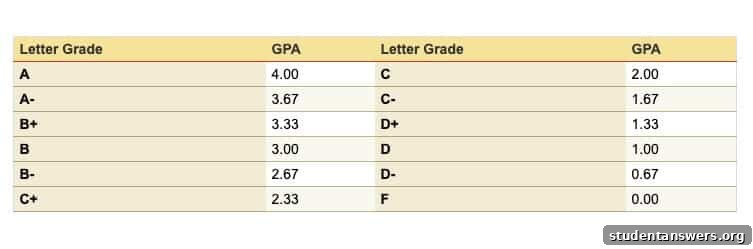
To find the total grade points for a single course, you multiply the course’s credit hours by the grade point value of the grade you earned. For example, earning a B (3.0 points) in a 3-credit course gives you 9.0 total grade points for that class (3.0 x 3 = 9.0).
Understanding Credit Hours
Credit hours represent the weight of a course. A 4-credit science lab will have a greater impact on your GPA than a 1-credit seminar. You can find the number of credit hours for each course on your syllabus or in your student information portal.
A Sample GPA Calculation
Let’s put it all together with an example. Imagine you are taking the following courses in a semester:
- Calculus I: 4 credit hours, Grade: C
- Spanish 102: 3 credit hours, Grade: B+
- Introduction to Philosophy: 3 credit hours, Grade: A-
- Biology 101 with Lab: 4 credit hours, Grade: B
First, convert the letter grades to their grade point values (using the standard scale):
- Calculus I: C = 2.0 grade points
- Spanish 102: B+ = 3.3 grade points
- Introduction to Philosophy: A- = 3.7 grade points
- Biology 101 with Lab: B = 3.0 grade points
Next, calculate the total grade points for each course by multiplying the grade points by the credit hours:
- Calculus I: 2.0 x 4 credits = 8.0 total grade points
- Spanish 102: 3.3 x 3 credits = 9.9 total grade points
- Introduction to Philosophy: 3.7 x 3 credits = 11.1 total grade points
- Biology 101 with Lab: 3.0 x 4 credits = 12.0 total grade points
Now, add up your total grade points: 8.0 + 9.9 + 11.1 + 12.0 = 41.0.
Then, add up your total credit hours: 4 + 3 + 3 + 4 = 14.
Finally, apply the GPA formula:
41.0 Total Grade Points / 14 Credit Hours = 2.93 GPA
Manually calculating this can be tedious. We recommend using an online GPA calculator to quickly check your standing. To find your cumulative GPA, you simply use the same formula but include the total grade points and credit hours from all semesters you have completed.
Immediate Strategies to Raise Your GPA This Semester
Now that you understand the mechanics, let’s focus on actionable steps you can take right now to improve your grades and boost your GPA before the semester ends.
Build Your Academic Support Network
You are not alone in this. Your university has a built-in support system designed to help you succeed. Your first step should be to connect with these resources. Talk to your academic advisor about your concerns. They can offer strategic advice on your course load and connect you with campus resources. Schedule meetings during your professors’ office hours for the classes you’re struggling with. Come prepared with specific questions to show you’re engaged. Finally, visit your college’s tutoring or academic support center. They offer free, specialized help that can make a massive difference.
Secure Every Possible Point
Many classes have points that are easier to earn than others. Homework, participation, and attendance are often graded on completion or effort rather than perfection. Make it a rule to turn in every single assignment on time, even if you feel it’s not your best work. Some points are better than none. Similarly, attend every lecture. You’ll not only absorb the material better but also catch important announcements and demonstrate to your professor that you’re committed. These small efforts create a buffer for your grade when it comes to high-stakes exams.
Re-evaluate Your Time Commitments
Extracurricular activities like clubs, sports, and music groups are a vital part of the college experience. However, if they are consuming too much of your time and your grades are suffering, it’s time to prioritize. This doesn’t mean you have to quit everything you love. Instead, take a hard look at your schedule and identify where you can temporarily scale back to dedicate more focused time to your studies. Remember, academics are your primary responsibility, and you can always increase your involvement in extracurriculars once your GPA is back on solid ground.
Master Your Study Habits
Many students arrive at college without ever learning how to study effectively. Simply re-reading notes or highlighting a textbook is a passive activity that leads to poor retention. It’s time to upgrade your study methods. Explore active recall techniques like using flashcards or trying to explain a concept aloud without looking at your notes. Implement spaced repetition, where you review material at increasing intervals over time. Use the Pomodoro Technique—studying in focused 25-minute bursts with short breaks—to maintain concentration and avoid burnout. A small change in how you study can lead to a significant improvement in your results.
Make a Strategic Course Adjustment
Sometimes, the best move is a tactical retreat. If you are in a class that is devastating your GPA and you see no path to recovery, look into your university’s policies. You may be able to change the course to a “pass/fail” grading option. This means the class won’t negatively impact your GPA as long as you pass. If things are truly dire, consider dropping the course altogether. While it may feel like a failure, it’s a strategic decision that allows you to focus your energy on your remaining classes and protect your overall GPA.
Long-Term Strategies for a Consistently High GPA
Improving your GPA in one semester is a great start, but maintaining it requires a long-term strategy. Here’s how to set yourself up for sustained academic success.
Choose Your Courses with a Strategic Mindset
When planning your schedule, be realistic about your workload. It’s tempting to load up on fascinating but notoriously difficult courses, but this can backfire. Balance your challenging required courses for your major with easier general education electives. Research professors using tools like Rate My Professors and ask upperclassmen for recommendations on courses that offer a good balance of interest and manageable difficulty. A course with more credit hours has a larger impact on your GPA, so be especially cautious about taking a difficult, high-credit course alongside an already heavy schedule.
Design a Balanced Semester Schedule
Don’t just think about what courses you’re taking; think about how they fit together. If you know you have to take a demanding “weed-out” course like organic chemistry or advanced calculus, build the rest of your schedule around it. Pair it with classes that are less time-intensive or that play to your strengths. This approach ensures you have enough time and mental energy to devote to the most challenging material without letting your other grades slide.
Align Your Major with Your Strengths
If you consistently struggle with the core courses in your major despite your best efforts, it may be a sign of a mismatch. A low GPA can sometimes be a signal that you’re not in the right field of study. This isn’t a failure—it’s a discovery. Talk to your advisor or a career counselor about your interests and skills. Changing your major to a field that genuinely excites you and aligns with your natural abilities can transform your academic experience and lead to a much higher GPA.
Your GPA is a Number, Not Your Identity
Finally, it’s essential to keep your GPA in perspective. While it is an important metric for things like scholarships or graduate school applications, it does not define your worth or your future potential. Most employers care far more about your practical skills, internship experience, personal projects, and ability to solve problems than they do about your GPA. If your GPA is low, simply leave it off your resume.
Focus on building a strong portfolio of experiences that demonstrate what you can do. A student with a 3.0 GPA and two relevant internships is often far more attractive to a hiring manager than a 4.0 student with no real-world experience. Use your time in college not just to earn grades, but to build skills, make connections, and become a capable, well-rounded individual. That is the true measure of success.