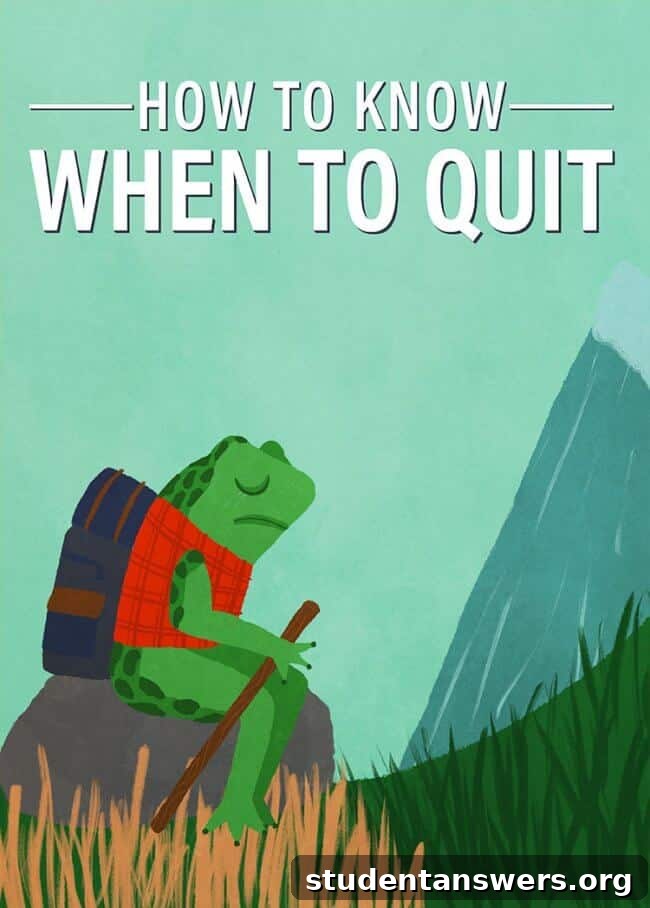

The Art of Quitting: Why Winners Quit and How You Can Too
We’ve all heard the timeless mantra: “Winners never quit, and quitters never win.” It’s plastered on motivational posters in gyms and high school locker rooms. It’s the driving force behind countless movie training montages. But what if this piece of conventional wisdom is not only wrong but actively harmful to your success? What if the real secret to winning is knowing precisely when to quit?
Marketing guru and bestselling author Seth Godin tackles this very idea in his transformative book, The Dip. Godin argues that winners, in fact, quit all the time. They are strategic quitters. They wisely abandon projects, jobs, and hobbies that are going nowhere to free up their time, energy, and resources. With this newfound focus, they can channel all their efforts into the one or two things that truly matter, pushing through the inevitable challenges to emerge victorious on the other side.
This concept can be difficult to accept. Quitting often feels like failure. It can trigger feelings of guilt, shame, and stubbornness. We might have wrapped our identity so tightly around a project that letting go feels like losing a part of ourselves. However, understanding the difference between strategic quitting and simply giving up is the key to unlocking extraordinary results in your personal and professional life.
The Myth of Unwavering Persistence
Our culture celebrates grit and perseverance above all else. We idolize the entrepreneur who mortgaged their house and the athlete who trained through injury. While determination is a valuable trait, blind persistence can be a trap. Sticking with a failing endeavor simply because you’ve already invested time and money is a cognitive bias known as the “sunk cost fallacy.” It’s the reason people stay in dead-end jobs, failing relationships, or pour money into a business that clearly isn’t working.
This relentless “never give up” mindset can lead to burnout, wasted potential, and missed opportunities. By refusing to quit the wrong things, you are implicitly saying “no” to the right ones. The time you spend on a dead-end project is time you can’t spend on one with massive potential. The energy you expend trying to fix something that’s broken beyond repair is energy you can’t use to build something amazing from the ground up.
Understanding The Dip: The Path to Mastery
To help us decide what to quit and what to stick with, Seth Godin introduces a simple but powerful framework centered around a concept he calls “The Dip.” The Dip is the long, arduous journey between starting something new (when it’s exciting and you’re making rapid progress) and achieving mastery (when you reap the rewards of being the best).
Think about learning a new skill. When you first start learning guitar, you quickly learn a few chords and can strum a simple song. It’s exciting! But soon, you hit a plateau. Progress slows down. Your fingers hurt, complex chords are frustrating, and sounding like your favorite artist seems impossible. This is The Dip. It’s the period of struggle where most people give up. It’s the same for starting a business, learning to code, or getting in shape. The initial enthusiasm wanes, the work gets hard, and the results seem to diminish.
However, The Dip is not a bad thing; it’s a feature, not a bug. The Dip creates scarcity, and scarcity creates value. The very fact that it is difficult to get through The Dip is what makes the skill or achievement on the other side so valuable. If it were easy to become a world-class neurosurgeon, a bestselling author, or a successful YouTuber, everyone would do it, and the rewards wouldn’t be as great. The Dip acts as a powerful filter, weeding out those who lack the dedication to push through. The extraordinary benefits—be it expertise, recognition, or profit—are reserved for those who see The Dip for what it is and find the strength to endure it.
The Two Traps to Avoid: The Cliff and The Cul-de-Sac
Not every challenge is a Dip worth pushing through. Godin identifies two other scenarios that are traps for your time and energy. Recognizing these is just as important as identifying a true Dip.
The Cliff
The Cliff is a situation where you can’t see the danger until it’s too late. The activity might seem enjoyable or harmless at first, but it eventually leads to a sudden and catastrophic drop-off. Think of smoking cigarettes. It provides a temporary pleasure for years, but the end result can be a sudden and irreversible health crisis. In a business context, this could be relying on a single technology platform that becomes obsolete overnight. With a Cliff, the longer you persist, the worse the fall. The only winning move is to quit, and quit as early as you can.
The Cul-de-Sac (The Dead End)
The Cul-de-Sac is perhaps the most common and insidious trap. This is a situation where you work and work, but you make no real progress. You’re not moving forward, but you’re not dramatically failing either. You’re just… stuck. This is the dead-end job with no opportunities for promotion or skill development. It’s the hobby you no longer enjoy but continue out of habit. The Cul-de-Sac is dangerous because it’s comfortable. It doesn’t demand much, but it slowly drains your potential and robs you of the energy you could be using to tackle a meaningful Dip. Quitting a Cul-de-Sac isn’t failure; it’s a strategic reallocation of your most precious resources.
How to Know When to Quit (And When to Persist)
So, how can you tell if you’re in a valuable Dip or a pointless Cul-de-Sac? Making the decision to quit should be a calculated, strategic choice, not an emotional reaction to a bad day. Before you make a move, ask yourself a series of critical questions.
Key Questions to Ask Yourself Before Quitting
- Is this a Dip, a Cliff, or a Cul-de-Sac? Be brutally honest with yourself. Are you facing a temporary setback on a path to mastery (a Dip)? Are you in a job that offers no growth and drains your soul (a Cul-de-Sac)? Or is the entire foundation of your project about to collapse (a Cliff)?
- Did I set quitting criteria beforehand? The best time to decide when to quit is before you even begin. For example: “I will work on this startup for two years. If it’s not profitable by then, I will quit.” Or, “I will try this new marketing strategy for three months. If I don’t see a 10% increase in leads, I will pivot.” Making the decision when you are calm and rational prevents you from quitting in a moment of panic.
- Is the reward on the other side of this Dip worth the effort? Pushing through a Dip is hard. Make sure the prize is worth the price. Is becoming “the best in the world” at this particular thing truly aligned with your long-term goals and values? If not, it may be the wrong Dip for you.
- Am I making measurable progress, however small? Even in the depths of a Dip, there should be some signs of forward momentum. Are you getting slightly better? Are you learning valuable lessons? If you’ve been stagnant for a long time with no signs of change, you might be in a Cul-de-Sac.
- Am I quitting because it’s hard, or because it’s wrong? There is a huge difference. Pushing through a Dip is supposed to be hard. That’s the point. But if you realize the fundamental premise of your project is flawed or it’s taking you in a direction you don’t want to go, quitting is the smartest possible move.
Conclusion: Embrace Strategic Quitting as a Superpower
The idea that you must finish everything you start is a recipe for mediocrity. True success doesn’t come from doggedly sticking to every single thing you try. It comes from having the courage and wisdom to quit the dead ends, the cliffs, and the Dips that aren’t worth your time. By strategically quitting, you reclaim your focus and energy. You create the space necessary to go all-in on the challenges that matter, the ones with asymmetric rewards on the other side.
Take a moment to evaluate the projects in your life. Identify the Cul-de-Sacs that are holding you back. Recognize the Dips that lead to outcomes you truly desire. Have the courage to quit the former so you can conquer the latter. Because winners don’t just never quit; winners know that quitting the right thing is the first step toward winning what truly counts.