

Your Roadmap to a Timely Graduation

The Ultimate Guide to Creating a College Graduation Plan That Guarantees You Finish on Time
It’s a startling reality: according to data from the U.S. Department of Education, a significant number of students who start college don’t finish within the traditional four years. In fact, for students who began their journey in 2006, only 59% had earned a degree six years later. The four-year graduation rate is even more concerning.
These statistics aren’t meant to scare you, but to highlight a critical truth: finishing college on time doesn’t happen by accident. It happens by design. The difference between walking across the stage in four years and spending an extra semester—or even a year—paying tuition often comes down to one thing: strategic planning.
So, why do so many students face delays? The reasons are numerous, from changing majors to underestimating course loads or missing key prerequisites. But your primary focus shouldn’t be on the problem; it should be on the solution. You need to ensure you’re not one of those statistics. This guide will show you exactly how to build a robust, fool-proof college graduation plan that not only keeps you on track but also reduces stress and saves you thousands of dollars.
Why a Detailed Graduation Plan is Your Most Valuable College Asset
Before we dive into the “how,” let’s establish the “why.” You might think your academic advisor handles all of this, but taking ownership of your academic path is a game-changer. A well-crafted graduation plan is more than just a list of classes; it’s a roadmap to your future. Here’s why it’s non-negotiable.
- It Saves You a Fortune: An extra year of college isn’t just an extra year of classes. It’s an extra year of tuition, fees, housing, and food. More importantly, it’s a year of lost income from the full-time job you could have started. A simple plan can literally save you tens of thousands of dollars.
- It Eliminates Last-Minute Panic: There’s no worse feeling than discovering in your senior year that you’re missing a required course that’s only offered in the fall. A proper plan helps you foresee these bottlenecks, especially with sequential courses or classes with limited availability, so you can navigate them with ease.
- It Maximizes Your College Experience: When you’re not constantly worried about meeting requirements, you have the mental bandwidth to focus on what truly enriches your education: internships, study abroad programs, undergraduate research, and leadership roles in clubs. A plan gives you the freedom to build a compelling resume, not just a transcript.
- It Puts You in Control: Relying solely on others for your academic future is a risky strategy. By creating your own plan, you gain a deep understanding of your degree requirements and become an active participant in your education. You can have more productive conversations with your advisor and make informed decisions about your future.
Creating Your 4-Year Graduation Plan: A Step-by-Step Guide
Ready to build your roadmap? The process is straightforward and empowering. Grab your computer, open a new spreadsheet, and let’s get started. Breaking it down into these manageable steps will turn a daunting task into an achievable one.
Step 1: Gather Your Essential Documents
You can’t draw a map without knowing the terrain. Before you start plotting out semesters, you need to collect three key resources from your university’s website or student portal:
- The University Catalog: This is your academic bible. It contains detailed information on every degree program, course description, and academic policy. Focus on the catalog from the year you started college, as your degree requirements are typically locked in to that version.
- Your Degree Audit or Checksheet: Most universities provide a tool (often called a Degree Audit, Degree Works, or a checksheet) that shows all your degree requirements and tracks which ones you’ve completed. This is the official checklist you need to complete. Print it out or have it open in a separate tab.
- Your Unofficial Transcript: This document shows every class you’ve taken and the grade you received. It’s crucial for confirming you’ve met the prerequisites for future courses.
Step 2: Deconstruct Your Degree Requirements
Now, look at your degree audit and break down your requirements into distinct categories. This helps you see the big picture. Most degrees consist of:
- General Education Requirements: These are the core classes all students must take, regardless of major (e.g., English Composition, History, a lab science, a fine arts course).
- Major Requirements: The specific, in-depth courses required for your field of study. Pay close attention to sequential courses (e.g., Accounting I before Accounting II).
- Minor or Concentration Requirements (if applicable): If you’ve declared a minor or a specific concentration within your major, list these courses separately.
- Free Electives: These are the “filler” credits you need to reach the total number required for graduation (usually around 120 credits). This is where you have the most flexibility.
- University-Specific Requirements: Some schools have unique requirements, like credits for “writing-intensive” courses or courses focused on cultural diversity. Don’t overlook these!
Step 3: Map Everything Out, Semester by Semester
This is where your spreadsheet comes into play. Create a grid with eight columns for each semester (Fall 1, Spring 1, Fall 2, etc.) and rows for the courses you’ll take.
Start by plugging in the “immovable rocks.” These are your prerequisite-heavy, sequential major courses. For example, if you’re a Computer Science major, your calculus and introductory programming sequences should be the first things you map out. Then, layer in your other major requirements.
Next, strategically sprinkle in your General Education requirements. A great strategy is to balance a heavy semester of major-specific courses with a lighter Gen Ed class to manage your workload. Finally, use your free electives to fill any remaining credit gaps.
Step 4: Review and Refine with Your Academic Advisor
Once you have a solid draft of your four-year plan, schedule a meeting with your academic advisor. This is a critical step. Instead of showing up and asking, “What should I take?” you can present your plan and say, “This is what I’ve mapped out to graduate in four years. Can you review it and see if I’ve missed anything?”
Your advisor can offer invaluable insights, spot potential issues you overlooked, and suggest alternative courses. This proactive approach shows you’re serious about your education and makes your advising sessions far more productive.
Download Your Free Graduation Planning Toolkit
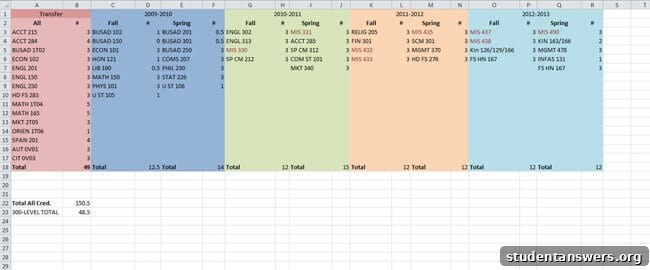
Feeling like this is a lot to manage? I’ve created the exact spreadsheet I used to plan my own path to a four-year graduation. It’s designed to be simple, effective, and fully customizable. I’m giving it away for free to help you get started.
When you sign up below, I’ll send you the Graduation Planning Worksheet immediately. But that’s not all.
You’ll also receive a complimentary copy of my 100+ page e-book, 10 Steps to Earning Awesome Grades (While Studying Less). This guide is packed with actionable strategies that students have used to transform their academic performance.
Inside the book, you’ll discover how to:
- Finally overcome procrastination and manage your time effectively.
- Get significantly more out of your lectures and class time.
- Develop a note-taking system that makes studying for exams a breeze.
- Read textbooks efficiently without wasting hours.
- And much more, including tool recommendations and resource guides.
If you want this complete toolkit—the planning spreadsheet and the book—just let me know where to send it:
Get My Free Toolkit Now
I’ll also keep you in the loop with new guides and videos designed to help you master college and succeed in your career.
Advanced Strategies to Stay Ahead of the Curve
A semester-by-semester plan is your foundation. But to truly secure an on-time graduation, you can employ a few advanced tactics.
Leverage Summer and Winter Sessions
Don’t overlook the power of intersessions. Taking just one or two classes over the summer can be a strategic move. You can use it to catch up if you fall behind, get ahead on requirements to lighten a future semester’s load, or even complete a difficult course without the distraction of a full schedule.
Explore Credit by Examination
Did you take AP or IB classes in high school? Make sure you’ve received all the college credit you’re entitled to. Furthermore, look into your university’s policy on CLEP (College-Level Examination Program) exams. You can potentially “test out” of introductory-level general education courses, saving both time and money. Check out this guide on how to test out of college courses to learn more.
Conduct a Regular “Plan Audit”
Your graduation plan is a living document, not something you create once and forget. At the end of each semester, take 30 minutes to review and update it. Did you change your minor? Did you discover a new interest you want to pursue with an elective? Regular check-ins ensure your plan stays aligned with your goals and realities.
Take Control of Your College Journey Today
Graduating from college on time is one of the most significant financial and professional decisions you’ll make as a young adult. It requires foresight, diligence, and a commitment to being the architect of your own education. By following the steps outlined above and using the right tools, you can move from hoping you’ll graduate on time to ensuring it.
What’s your biggest challenge when it comes to academic planning? Share your thoughts or questions in the comments below!
If you found this guide helpful, subscribe on YouTube for more videos on how to dominate your classes and build an amazing future.