

How to Stay Focused: 6 Powerful Strategies to Conquer Distraction
In his transformative book, The War of Art, author Steven Pressfield gives a name to the invisible force that holds us back from achieving our goals. He calls it Resistance.
“Resistance cannot be seen, touched, heard, or smelled. But it can be felt. We experience it as an energy field radiating from a work-in-potential. It’s a repelling force. It’s negative. Its aim is to shove us away, distract us, prevent us from doing our work.”
In simpler terms, Resistance is the nagging, internal enemy that fuels procrastination and sabotages our best intentions. It’s the reason we scroll through social media when a deadline looms or suddenly decide to clean the entire house when we should be studying. You can’t fight it physically or wish it away. The battle against Resistance is a daily one, and the most powerful weapon in your arsenal is focus.
If you take only one thing away from this article, let it be this: cultivate a singular focus. Scientific research confirms that our brains are designed for serial processing, meaning they excel at handling one task at a time. The modern myth of multitasking is just that—a myth. We are not wired to perform multiple complex tasks simultaneously; we are simply switching between them rapidly, which drains our mental energy and diminishes the quality of our work.
The problem is that our hyper-connected world constantly bombards us with notifications, emails, and endless streams of information, training our brains for distraction. So, how can you reclaim your ability to concentrate and stay focused on what truly matters? Here are six proven strategies to help you conquer Resistance and unlock your full potential.
1. Choose Your Most Important Task the Night Before
“Unlimited possibilities are not suited to man; if they existed, his life would only dissolve in the boundless. To become strong, a man’s life needs the limitations ordained by duty and voluntarily accepted.” – I Ching
Decision fatigue is real. Waking up and immediately having to decide what to work on can be paralyzing. You can eliminate this morning friction with a simple yet powerful habit. At the end of each workday or study session, ask yourself one question: “If I could only accomplish one thing tomorrow, what would have the greatest impact?”
Identify that single, most important task (MIT) and write it down. When you wake up, you’ll have a clear, predetermined mission. Your goal is to tackle this one task before anything else—before checking email, before scrolling through social media, and before getting pulled into less important activities. This approach achieves two critical goals:
- It provides a clear starting point, making it easier to overcome the initial inertia of beginning your work.
- It builds powerful momentum. Once you’ve completed your most significant task, you’ll feel a sense of accomplishment that fuels your motivation for the rest of the day.
Starting with one focused task doesn’t mean you’ll only do one thing all day. It’s about creating a disciplined starting ritual that guarantees progress on what matters most.
2. Create a Structured Weekly Plan
While focusing on one task each morning is a great starting point, a broader strategy is needed to manage multiple responsibilities effectively. This is where weekly planning comes in. Setting aside 60-90 minutes at the beginning of each week—perhaps on a Sunday evening or Monday morning—to map out your commitments can dramatically reduce anxiety and enhance your focus.
Using a digital calendar, a planner, or a simple document, block out dedicated time for all your essential activities: classes, study sessions, assignments, exercise, and social time. A well-structured weekly plan acts as a roadmap, providing clarity and reassurance.
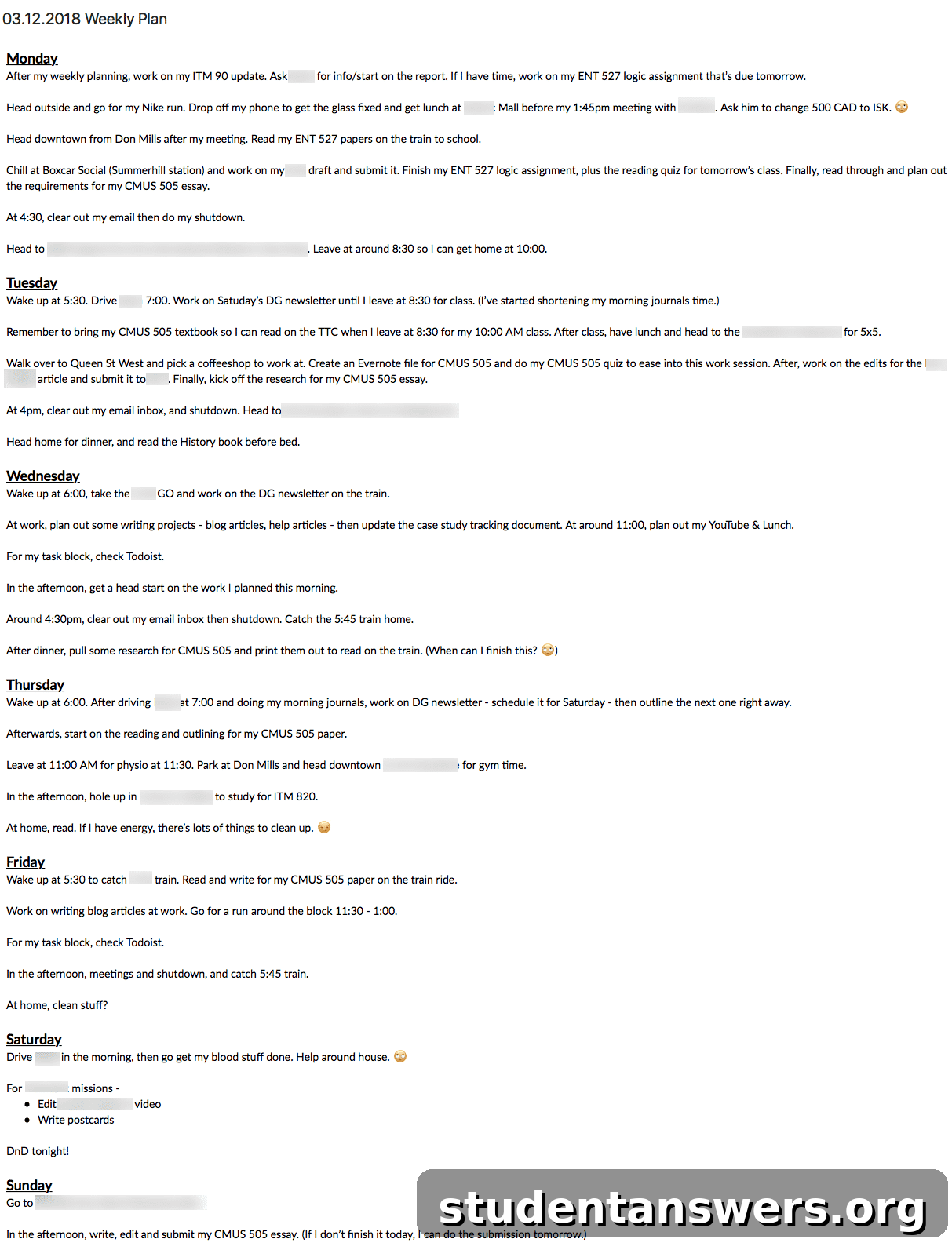
The magic of a weekly plan is that it liberates your mind. When you are working on a specific task during its designated time block, you can fully immerse yourself in it. You don’t have to waste mental energy worrying about when you’ll find time for your other obligations because you already have a plan. You know that as long as you stick to the schedule, everything important will get done. This frees you from the mental clutter of an endless to-do list and allows you to be present and effective in the moment.
3. Protect Your Focus Blocks by Eliminating Shallow Work
In his influential book Deep Work, Cal Newport introduces a critical distinction between two types of work: deep and shallow. He defines shallow work as:
“Noncognitively demanding, logistical-style tasks, often performed while distracted. These efforts tend to not create much new value in the world and are easy to replicate.”
Shallow work includes activities like responding to non-urgent emails, browsing social media, or running simple errands. These tasks feel productive but contribute little to your long-term goals. Deep work, on the other hand, is the focused, uninterrupted concentration on a cognitively demanding task that pushes your abilities and creates real value.
Newport issues a stark warning about the dangers of living in a state of constant shallowness: “Spend enough time in a state of frenetic shallowness and you permanently reduce your capacity to perform deep work.” Every time you yield to the temptation to quickly check your phone or switch tabs, you are training your brain to crave distraction, thereby weakening your “focus muscle.”
To counteract this, you must actively protect your scheduled blocks of deep work. Use technology to fight technology. Apps like Freedom (for Mac/Windows/iOS) or digital wellness features built into Android and iOS can block distracting websites and applications for set periods. These tools create a fortress around your attention, making it impossible to give in to your worst impulses. By fiercely guarding your focus blocks, you train your brain to sustain concentration for longer periods, which is the key to producing high-quality work.
4. Defend Your Rest as a Strategic Necessity

In our hustle-obsessed culture, rest is often mistaken for laziness. This could not be further from the truth. Getting adequate sleep and taking intentional breaks are not signs of weakness; they are essential components of peak performance. In athletic training, rest periods, or “unloading” phases, are strategically used to allow the body to recover and prepare for more intense work. The same principle applies to your brain.
Committing to 7-9 hours of quality sleep each night requires discipline. It means turning off Netflix even when the next episode is calling your name and putting your phone away an hour before bed. But the rewards are immense. Sleep is when your brain consolidates memories, processes information, and recharges for the next day. Neglecting it is a surefire way to sabotage your focus and cognitive abilities.
Stephen Covey, in The 7 Habits of Highly Effective People, emphasizes this with the seventh habit: “Sharpen the Saw.” He illustrates the point with a quote attributed to Abraham Lincoln:
“Give me six hours to chop down a tree and I will spend the first four sharpening the axe.”
Your mind is your axe. Rest, relaxation, and recreation are how you sharpen it. So, if you find yourself staring blankly at a screen, unable to focus, don’t beat yourself up. It might be a sign that you need a break. Step away, take a walk, and have the courage to call it a day and try again tomorrow, fully rested and ready to conquer.
5. Build a Powerful Routine to Automate Success

Getting started is often the hardest part of any task. You can make it significantly easier by establishing a consistent routine. Routines reduce cognitive load by automating the small decisions that can drain your willpower, such as where to study, when to start, and what you need.
Create a dedicated study environment, even if it’s just a specific corner of your room or a particular table at the library. Your brain will begin to associate this space with focused work. Establish a pre-work ritual, a short series of actions that signal it’s time to concentrate. This could be as simple as making a cup of tea, putting on a specific playlist, and opening your textbook.
Here are some elements you can build into your focus routine:
- A Consistent Time and Place: Work on specific subjects at the same time and in the same location each week.
- A Dedicated Soundtrack: Use focus-enhancing music or ambient sounds. Services like Brain.fm or instrumental playlists on Spotify and YouTube are excellent for this. Familiar, lyric-free music is less likely to divert your attention.
- All Necessary Supplies: Have everything you need—notebooks, pens, water, and chargers—within arm’s reach before you begin, so you don’t have to interrupt your flow.
As author Pierce Howard notes in The Owner’s Manual for the Brain, “The more routine a stimulus is the less it interferes with rival stimuli.” By making your work environment and process predictable, you create a seamless on-ramp into a state of deep focus.
6. Make Focus Your Default Lifestyle
“Don’t take breaks from distraction. Instead take breaks from focus.” – Cal Newport, Deep Work
This final tip is a fundamental mindset shift. To truly master your attention, focus shouldn’t be something you only do when you have a big project. It should be your default state, and distraction should be the scheduled break.
Think of it like physical fitness. You wouldn’t expect to get in shape by eating junk food all week and only having a salad on Sunday. To build physical health, you make healthy eating and exercise your baseline. Similarly, to build mental fitness, you must make focus your baseline.
This doesn’t mean you can never relax or browse the internet. It means you do so intentionally. Instead of letting distractions pull you away from your work, schedule specific times for them. For example, you might work in focused 90-minute blocks with a 15-minute break in between to check your phone or stretch.
A powerful way to practice this is to integrate periods of undistracted reading into your day. Start by reading a physical book for 15 minutes each morning before you even look at your phone. Carry a book with you to fill those small pockets of downtime—like waiting in line or commuting—that you would normally fill with mindless scrolling. This practice trains your brain to be comfortable with quiet concentration.
Conclusion: Winning the Daily Battle
“Resistance has no strength of its own. Every ounce of juice it possesses comes from us. We feed it with power by our fear of it. Master that fear and we conquer Resistance.” – Steven Pressfield, The War of Art
Staying focused is a continuous struggle against both internal and external forces of distraction. But it is a battle you can win. By implementing these strategies, you can systematically optimize your life to conquer Resistance not just once, but day after day.
Each time you choose to focus, you build momentum. Each protected work block strengthens your ability to concentrate. When you string together days, weeks, and months of consistent, focused effort, you create the conditions for extraordinary results. The magic happens not in a single heroic burst of productivity, but in the quiet, daily commitment to doing the work that matters.