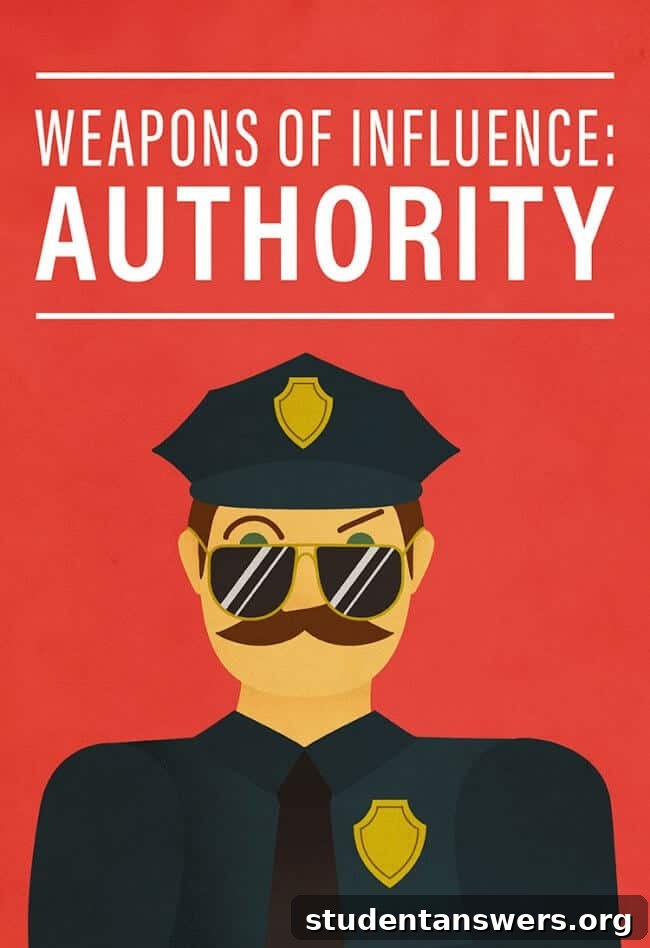

Mastering the Principle of Authority: A Deep Dive into Cialdini’s ‘Influence’
Have you ever noticed how a uniform or a formal title can instantly change your perception of someone? I considered wearing a suit for this discussion, but I decided against it. Why? Because authority, or even just the *illusion* of it, is one of the most powerful tools of persuasion. A suit might make you automatically trust my words, even if your own experience tells you otherwise. My goal isn’t to be blindly believed; it’s to explore the fascinating psychology behind *why* we’re so inclined to trust.
This deep-seated deference to authority is a fundamental aspect of human behavior, and it’s the fifth major principle of persuasion detailed by Dr. Robert Cialdini in his groundbreaking book, “Influence: The Psychology of Persuasion.” We are conditioned from birth to obey authority figures—parents, teachers, doctors, and law enforcement. This system is largely beneficial; it allows for a structured, functioning society. However, this same instinct can be exploited, leading us to make poor decisions or follow orders without critical thought. Today, we’ll dissect this powerful principle, understand its symbols, and learn how to both use it ethically and defend ourselves against its manipulation.
What is the Principle of Authority?
At its core, the principle of authority states that people are more likely to comply with requests made by someone they perceive as a legitimate authority figure. This is a mental shortcut, or heuristic, that our brains use to simplify decision-making. Instead of analyzing every situation from scratch, we defer to the judgment of experts. When a doctor prescribes medication, we take it. When a financial advisor suggests an investment, we consider it. This shortcut saves time and mental energy, and in most cases, it serves us well.
The problem arises when our perception of authority is triggered by mere symbols rather than genuine substance. Cialdini highlights that we often don’t have the time or knowledge to verify someone’s expertise, so we rely on superficial cues. These symbols can be so potent that they can persuade us to act against our own judgment, a phenomenon demonstrated in some of the most famous experiments in psychology.
The Three Key Symbols of Authority
Since true authority can be difficult to verify, our brains look for simple, recognizable symbols. Cialdini identifies three of the most effective types: titles, clothing, and trappings.
1. Titles
A title is perhaps the most straightforward and yet most powerful symbol of authority. Titles like “Dr.,” “Professor,” “CEO,” or “Judge” carry an immediate weight of expertise and respect. Studies have shown that people not only defer to individuals with prestigious titles but also perceive them differently. For example, in one study, a man introduced as a “Professor” to a group of students was perceived as being significantly taller than when he was introduced as a “Student.” The title alone altered their physical perception of him. This automatic deference can be dangerous when the title is unearned or irrelevant to the situation at hand. Think of celebrities endorsing medical products—their title is “Actor,” not “Doctor,” yet their perceived authority influences millions.
2. Clothing
Just as I considered wearing a suit, the right attire can create an instant aura of authority. A police officer’s uniform, a physician’s white lab coat, or a pilot’s crisp outfit all command a level of respect and compliance. This response is deeply ingrained. In one experiment, a researcher dressed in a security guard’s uniform was able to get passersby to comply with unusual requests, like picking up a paper bag from the ground or giving a stranger money for a parking meter. When the same researcher made the same requests dressed in casual street clothes, compliance dropped dramatically. The uniform, not the person or the logic of the request, was the trigger for obedience.
3. Trappings
The third category, trappings, refers to the accessories and settings associated with status and authority. This includes expensive cars, luxury watches, fine jewelry, and impressive office spaces. These items signal success and position, which we subconsciously equate with credibility and expertise. Con artists have long understood this. By renting a luxury car or a prestigious office, they can create an illusion of success that makes their fraudulent schemes seem more legitimate. We assume that someone with such impressive possessions must be knowledgeable and trustworthy, and we let our guard down.
Authority in Action: Classic Studies and Real-World Examples
To truly grasp the power of authority, we need to look at how it plays out in controlled experiments and real-life scenarios.
The Milgram Experiment: A Chilling Demonstration
Perhaps the most famous and unsettling study on authority is the Milgram experiment, conducted by psychologist Stanley Milgram in the 1960s. Participants were instructed by an authority figure—an experimenter in a white lab coat—to deliver what they believed were increasingly powerful electric shocks to another person (an actor) in a separate room. Despite the actor’s screams of pain and pleas to stop, a shocking two-thirds of participants continued to administer the shocks all the way to the highest, most dangerous level, simply because the authority figure told them to continue. The experiment starkly revealed our profound, and often dangerous, tendency to obey authority, even when it means violating our own moral principles.
Frank Abagnale Jr.: The Master of Deception
The story of Frank Abagnale Jr., immortalized in the film Catch Me If You Can, is a masterclass in exploiting the symbols of authority. As a young man, Abagnale successfully posed as an airline pilot, a doctor, and a lawyer. He understood that if he looked the part, no one would question his credentials. By donning a pilot’s uniform, he was able to cash fraudulent checks and gain access to secure areas. By wearing a doctor’s coat and carrying a stethoscope, he was able to walk into a hospital and get a supervisory position. He didn’t have the expertise, but he had the symbols, and that was enough to fool almost everyone.
How to Defend Yourself Against Authority Manipulation
Authority is a powerful tool for influence, but it’s not foolproof. By developing a conscious awareness of its effects, you can protect yourself from being unduly persuaded. Cialdini suggests asking two critical questions when confronted with an authority figure’s influence attempt.
- Is this authority truly an expert?
This question forces you to look beyond the symbols and focus on the substance. Does this person have genuine credentials and knowledge in this specific area? An actor who plays a doctor on TV is an expert in acting, not medicine. A successful businessperson might be an expert in their industry, but that doesn’t make them an expert on health or relationships. Always check to see if their expertise is relevant to the advice they are giving. - How truthful can we expect this expert to be?
Even a legitimate expert might not be presenting information in an impartial way. Consider their motives. Do they have something to gain from your compliance? A financial advisor who earns a commission on certain products may steer you toward those products, even if they aren’t the best fit for you. A doctor who receives funding from a pharmaceutical company might be more inclined to prescribe that company’s drugs. Being aware of potential biases can help you evaluate their recommendations more critically.
Conclusion: Wielding Authority with Wisdom
The principle of authority is an essential pillar of social order and a valuable shortcut in our daily lives. Deferring to genuine experts saves us time and leads to better outcomes. However, our automatic deference makes us vulnerable to manipulation by those who merely display the symbols of authority without the underlying expertise. By understanding how titles, clothing, and trappings trigger our compliance, we can begin to see past the illusion.
The key is not to reject authority altogether but to cultivate a habit of mindful questioning. By learning to distinguish between legitimate expertise and the mere appearance of it, you can harness the benefits of expert advice while protecting yourself from those who would use this powerful principle to exploit your trust. True power lies not in blind obedience, but in the ability to think for yourself and make informed, conscious decisions.