
Master Your Future: A Guide to Building Skills, Expanding Vocabulary, and Solving Hard Problems
In a world defined by constant change, the ability to adapt, learn, and overcome challenges is more valuable than ever. Whether you’re a student mapping out your future, a recent graduate navigating the job market, or anyone looking to sharpen their intellectual toolkit, a proactive approach to self-development is your greatest asset. This guide provides actionable strategies to tackle three fundamental areas of personal growth: building career-defining skills, genuinely expanding your vocabulary, and developing a resilient approach to complex problems.
We will move beyond quick fixes and dive into sustainable methods that create lasting change. From future-proofing your career to communicating with precision and tackling academic hurdles with confidence, these principles will equip you with the tools you need to thrive.

Part 1: How to Build Skills for a Flexible and Resilient Career
The traditional idea of a linear career path is fading. The modern job market is dynamic, rewarding those who can pivot, learn new technologies, and apply their knowledge across different industries. Relying solely on a degree is no longer enough. To build true career security, you must cultivate a portfolio of specific, high-demand skills.
Identify and Prioritize High-Impact Skills
The first step is to understand which skills offer the most leverage. These can be broken down into two categories:
- Hard Skills: These are teachable, technical abilities that can be measured. Examples include coding (Python, JavaScript), data analysis (SQL, Excel), digital marketing (SEO, Google Analytics), graphic design (Adobe Creative Suite), or proficiency in a specific software like WordPress. A great way to deepen your technical knowledge on a platform like WordPress is by reading expert guides like Smashing WordPress: Beyond the Blog.
- Soft Skills: These are interpersonal attributes that determine how you work and interact with others. Examples include communication, critical thinking, problem-solving, collaboration, and emotional intelligence. While harder to quantify, they are often the deciding factor in hiring and promotion.
To choose which skills to focus on, research job descriptions for roles you find interesting. What tools and abilities appear repeatedly? What are industry leaders talking about online? This will give you a clear roadmap for what the market values.
Actionable Steps to Acquire New Skills
Once you’ve identified the skills, it’s time to learn them. Here’s how:
- Leverage Online Learning Platforms: Websites like Coursera, edX, and Skillshare offer courses from top universities and industry experts on virtually any topic. Many offer certificates you can add to your LinkedIn profile.
- Start a Personal Project: The best way to solidify a new skill is to apply it. If you’re learning to code, build a simple app. If you’re learning graphic design, create a portfolio of personal branding projects. A powerful way to showcase your abilities is to build a personal “love letter site,” a website dedicated to showing a specific company why you are the perfect fit, demonstrating your skills in a real-world application.
- Read Voraciously: To gain deep knowledge, go beyond blog posts. Book series like A Book Apart offer concise, expert-level insights into specific web design and development topics. For developing focus, a crucial meta-skill, Cal Newport’s Deep Work: Rules for Focused Success in a Distracted World is an essential read.
- Find a Community: Join online forums, Discord servers, or local meetups related to your chosen skill. Engaging with a community accelerates learning, provides support, and opens up networking opportunities. The College Info Geek Community is a great place to connect with other ambitious students.
Part 2: How to Genuinely Expand Your Vocabulary
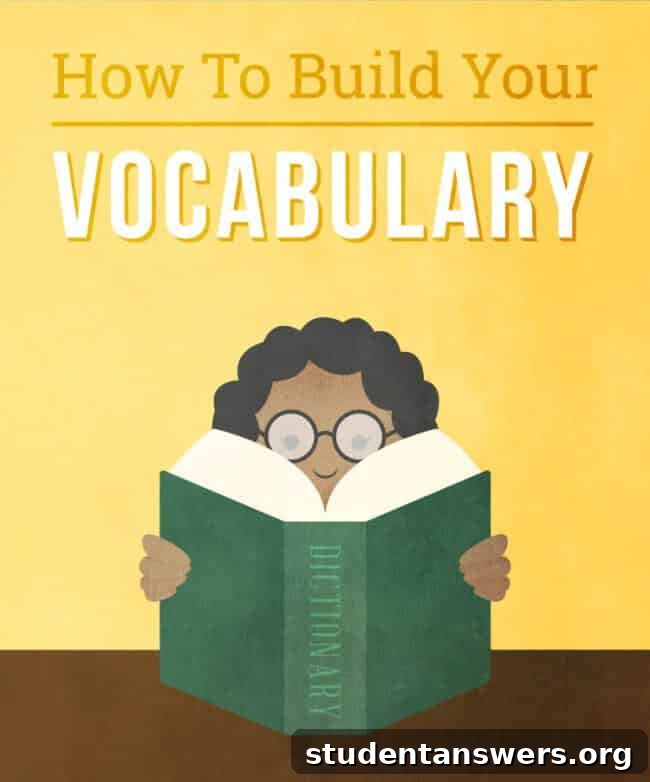
A rich vocabulary is a powerful tool. It allows you to express ideas with nuance and precision, makes your writing more compelling, and enhances your comprehension of complex texts. However, many people approach vocabulary building the wrong way, relying on a thesaurus as a crutch, which can lead to awkward and unnatural-sounding sentences. True vocabulary expansion is about internalizing words, not just swapping them.
Active Strategies for Lasting Vocabulary Growth
- Read Widely and Actively: This is the cornerstone of vocabulary building. Don’t just stick to one genre. Read fiction, non-fiction, data-driven journalism from sites like FiveThirtyEight, and even thought-provoking webcomics like Existential Comics or SMBC. When you encounter a new word, don’t just skip it. Look it up, understand its meaning in context, and perhaps jot it down in a notebook.
- Embrace Spaced Repetition Systems (SRS): Your brain retains information better when you review it at increasing intervals over time. This is known as the spacing effect. SRS apps like Anki or Quizlet automate this process. Create digital flashcards for new words with the definition, a sample sentence, and even its etymology. This is a scientifically proven way to remember more of what you learn.
- Dive into Etymology: Understanding the roots of words (often from Latin and Greek) is like having a cheat code for the English language. Once you know a root, you can often decipher the meaning of unfamiliar words. Books by Mark Forsyth, such as The Etymologicon and The Horologicon, make this exploration fascinating and fun.
- Practice Using New Words: Knowledge becomes permanent through application. Make a conscious effort to use your newly learned words in conversations, emails, or personal writing. The goal isn’t to sound pretentious but to become comfortable and natural with a wider range of language.
- Engage in Structured Debate: Platforms that encourage reasoned arguments, like Debate.org, the community at LessWrong, or even the subreddit r/changemyview, force you to articulate your thoughts clearly and defend your positions, which is excellent practice for deploying a precise vocabulary.
Part 3: How to Conquer Frustrating Homework and Academic Problems
Every student has faced it: a problem that feels utterly impossible. You’ve read the chapter, reviewed your notes, but you’re still stuck. Frustration builds, and it’s tempting to give up. However, learning how to approach these roadblocks is a critical skill in itself, one that builds resilience and deepens your understanding.
A Systematic Approach to Getting Unstuck
When you hit a wall, don’t just try the same failed approach over and over. Instead, work through a structured process:
- Take a Strategic Break: When you’re frustrated, your brain is locked in a focused, analytical mode that can lead to tunnel vision. Stepping away allows your brain to switch to its “diffuse mode,” where new connections can be made in the background. As explained in this video on strategic breaks, even a short 5-10 minute walk can be enough to reset your perspective.
- Deconstruct the Problem: Read the question again, slowly. Break it down into its smallest components. What information are you given? What is the ultimate goal? Are there any key terms or constraints you might have overlooked? Often, misunderstanding a small part of the problem is the root cause of the block.
- Try the Feynman Technique: Attempt to explain the problem and your attempted solution out loud to someone else, or even to an inanimate object like a rubber duck. The act of articulating your thought process forces you to confront gaps in your logic and understanding. You’ll often discover your own mistake as you try to explain it.
- Consult Different Sources: Your textbook isn’t the only source of truth. Look for alternative explanations on YouTube (like Khan Academy), in other textbooks, or on educational forums. Seeing the same concept explained in a different way can often make it click.
- Work Backwards: If possible, start from the solution and try to work your way back to the problem statement. This can reveal the necessary steps and logic you were missing when moving forward.
- Don’t Be Afraid to Ask for Help: If you’ve genuinely tried these steps, it’s time to seek help. Go to your professor’s office hours, form a study group with classmates, or visit your school’s academic resource center. Asking for help is a sign of strength, not weakness.
Conclusion: The Path to Continuous Improvement
Building skills, expanding your vocabulary, and developing robust problem-solving strategies are not one-time tasks; they are lifelong pursuits. Each challenge you overcome and every new thing you learn compounds over time, making you a more capable, confident, and adaptable person. Embrace curiosity, stay persistent in the face of difficulty, and commit to the process of continuous growth. The future belongs to those who never stop learning.
For more tools and guides to help you on your journey, explore our comprehensive Resources page for students and lifelong learners.