The Student Success Triangle: Why Grades Alone Won’t Secure Your Future
Are you a student laser-focused on achieving a perfect GPA? While academic excellence is commendable, an exclusive obsession with grades is a critical mistake. It’s a narrow approach that overlooks the broader landscape of what truly builds a successful and fulfilling career. Many students invest years of their lives and accumulate significant debt for a degree, yet they neglect the very activities that will set them apart from the crowd.
As entrepreneur Gary Vaynerchuk has pointed out, it’s baffling why anyone would believe a piece of paper, which millions of others also possess, is a guaranteed ticket to success without any additional effort to build a unique profile. The harsh reality is that students who only bury their heads in textbooks are tapping into just one-third of their true potential. They are ignoring two other pillars that are equally, if not more, important for long-term achievement.
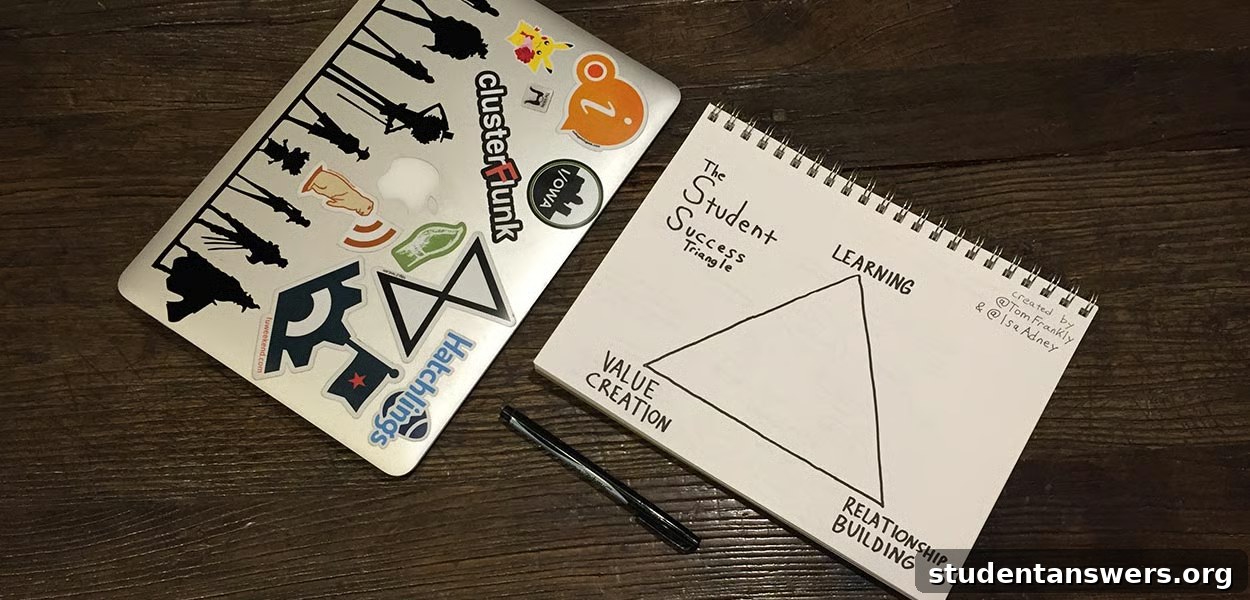
To truly thrive, both during your studies and long after graduation, you must balance your efforts across three fundamental areas. I call this powerful framework the Student Success Triangle.
The three interconnected pillars of this triangle are:
- Learning: The acquisition of knowledge and skills.
- Value Creation: The application of your knowledge to create tangible outcomes.
- Relationship Building: The cultivation of a strong, supportive, and diverse network.
Imagine these three points as the vertices of an equilateral triangle. Each one is just as important as the others. Neglecting one side weakens the entire structure. Let’s explore why each component is vital for unlocking your full potential.
Pillar 1: Deep and Continuous Learning
This is the most obvious part of the college experience. You attend lectures, read textbooks, and write essays to learn. This foundation is absolutely essential. Learning expands your mental “map” of the world, helping you understand reality more accurately. The more you learn, the better equipped you are to solve complex problems, make informed decisions, and avoid common pitfalls.
“Being ignorant is not so much a shame, as being unwilling to learn.” – Benjamin Franklin
However, true learning goes far beyond what’s required for an exam. It’s about cultivating an insatiable curiosity. It means reading books that aren’t on your syllabus, taking online courses to develop practical skills, and exploring subjects outside your major. This interdisciplinary knowledge is where true innovation happens. The ability to connect disparate ideas and create something new is a superpower in today’s economy. Effective learning isn’t just about memorizing facts; it’s about understanding concepts so deeply that you can apply them in novel situations and explain them clearly to others.
Pillar 2: The Art of Value Creation
Your ability to succeed in the world is directly tied to your ability to create value for others. Value is simply something that other people find useful, desirable, or helpful—so much so that they are willing to exchange something for it, whether it’s their money, time, or attention. Your grades represent theoretical knowledge, but value creation is the proof that you can apply it.
Unless you plan to live off charity, you must produce something of value to sustain yourself. Money, at its core, is a measure of this value. To earn it, you must create it. The more value you can provide, the more opportunities and compensation you will command. A minimum-wage job creates a certain level of value, but to achieve ambitious goals, you must develop high-value skills.
“Make something people want… There’s nothing more valuable than an unmet need that is just becoming fixable. If you find something broken that you can fix for a lot of people, you’ve found a gold mine.” – Paul Graham, Y Combinator founder
For a student, creating value can take many forms. It could mean:
- Securing an internship and contributing meaningfully to projects.
- Starting a side hustle, like web development or graphic design for local businesses.
- Building a personal project, such as coding an app, writing a blog, or starting a YouTube channel about your passion.
- Volunteering for a cause you care about and developing leadership skills.
- Conducting research with a professor, contributing to the body of knowledge in your field.
Each of these activities demonstrates your ability to do more than just pass tests. They build a portfolio of real-world accomplishments that make you infinitely more attractive to employers, collaborators, and clients.
Pillar 3: The Power of Relationship Building
Finally, we arrive at the most commonly neglected pillar: relationship building. We live in a deeply social world. Almost no significant achievement is accomplished in isolation. You can write the most brilliant novel in history, but without relationships, you won’t find an editor, a publisher, or an audience to share it with. Your work will remain an undiscovered pile of paper.
When Gary Vaynerchuk mentioned he’d send his kids to college primarily for the social aspect, he wasn’t dismissing learning. He was highlighting the profound importance of developing social maturity and learning how to connect with people. This is about more than just making friends; it’s about intentionally building a diverse network of peers, mentors, and advocates.
We diligently schedule time for classes and homework. We might even carve out time for a side project. But how often do we consciously schedule time to build relationships? This means:
- Connecting with Professors: Go to office hours not just to ask about grades, but to discuss ideas and seek mentorship.
- Networking with Peers: Form study groups, collaborate on projects, and support the ambitions of your classmates. Your peers today will be your professional network tomorrow.
- Engaging with Alumni: Reach out for informational interviews to learn about their career paths and gain valuable advice.
- Showing Appreciation: A simple thank-you note or a public acknowledgment of someone’s help can strengthen a connection immensely. A core part of networking is giving, not just taking.
Building relationships is about fostering genuine connections. It’s about being curious about other people, listening to their stories, and finding ways you can help them. This is the pillar that opens doors you never knew existed.
The Synergistic Power of the Triangle
The true magic of the Student Success Triangle is that the three pillars are not independent; they are deeply complementary. Strengthening one area automatically boosts the other two, creating a powerful upward spiral of growth. Think of it as a system where each part feeds the others.
How Learning Boosts the Other Pillars
- Benefits Value Creation: The more you know, the more you can create. Deep knowledge allows you to move beyond being a mere technician and become an innovator who can devise new solutions. Cross-disciplinary learning is the fuel for creativity and problem-solving.
- Benefits Relationship Building: Knowledge makes you a more interesting and engaging person. It broadens the range of topics you can discuss, allowing you to connect with a wider variety of people on a deeper level.
How Value Creation Boosts the Other Pillars
- Benefits Learning: Applying your knowledge is the fastest way to truly learn. Building a project forces you to move from theory to practice, solidifying your understanding and exposing gaps in your knowledge more effectively than any exam ever could. This is “learning by doing.”
- Benefits Relationship Building: Having something to show—a project, a portfolio, a successful event you organized—makes you a magnet for interesting people. It proves your passion and competence, giving you credibility and a foundation upon which to build new relationships.
How Relationship Building Boosts the Other Pillars
- Benefits Learning: Conversations with diverse people expose you to new perspectives, ideas, and information in a dynamic way that books cannot replicate. A mentor can guide your learning path, and a peer can explain a concept in a new way that finally makes it click.
- Benefits Value Creation: Your network provides feedback on your work, connects you with collaborators for larger projects, and informs you of problems that need solving. Opportunities for internships, jobs, and freelance gigs almost always come through people you know.
Beyond Graduation: A Lifelong Framework
The Student Success Triangle isn’t just a strategy for college students. It is a timeless framework for personal and professional development that remains relevant long after you receive your diploma. The need to learn, create, and connect never disappears. As long as you are breathing, there is room for growth in all three areas.
Stop focusing only on your transcript. Start thinking about your triangle. Learn constantly, create value consistently, and build relationships genuinely. To reach your highest potential, you need all three. You can’t neglect one and hope the other two will compensate. Which side of your triangle needs more of your attention today?