

Unlock Your Potential: How to Conquer Resistance with Lessons from “The War of Art”
There is a silent, invisible enemy that stands between you and your greatest ambitions. It’s the force that sabotages your new year’s resolutions, whispers excuses into your ear, and convinces you to start your masterpiece “tomorrow.” This enemy is not failure. It’s not a lack of talent. Steven Pressfield gave it a name in his transformative book: Resistance.
We often misidentify the problem. We look at our abandoned projects and blame Failure. We see Failure as a clumsy but sometimes insightful friend who, despite frequent letdowns, occasionally teaches us a valuable lesson. It’s easy to point the finger at Failure; it’s a visible outcome, a tangible result of our efforts not panning out. It takes the blame without complaint and reappears, ready to offer another lesson the next time we dare to try.
But while we are fixated on Failure, Resistance operates in the shadows. It’s the master puppeteer, the insidious force dedicated to one mission: to keep us from doing our work. It’s the reason the canvas remains blank, the business plan stays unwritten, and the gym shoes gather dust. It’s the internal friction you feel when you think about pursuing any activity aimed at a higher, better version of yourself. In his groundbreaking book, The War of Art, Steven Pressfield doesn’t just name this enemy; he gives us a battle plan to defeat it.
What Exactly Is Resistance? Understanding Your True Adversary
To win any war, you must first understand your enemy. Pressfield defines Resistance as a universal, impersonal, and malevolent force that arises whenever we consider a commitment to a long-term goal that will lead to personal or spiritual growth. It’s not a personal failing or a psychological quirk; it’s a fundamental law of nature, as real and predictable as gravity.
Resistance manifests in countless ways, all designed to stop you before you even begin. Its most common disguises include:
- Procrastination: The most obvious form. It’s the voice that says, “I’ll do it later,” or “The conditions aren’t perfect yet.” It convinces you that tomorrow is always a better day to start.
- Rationalization: Resistance is a master of logic. It will construct airtight arguments for why you shouldn’t pursue your calling. “I’m too old.” “I don’t have the right degree.” “The market is too saturated.” These excuses sound so reasonable that we believe them without question.
- Fear: The fear of failure is a powerful tool for Resistance. But so is the fear of success. What if you write that book and it’s a hit? Your life will change. You’ll have expectations to live up to. Resistance uses this fear to keep you safely in your comfort zone.
- Perfectionism: The belief that you must get it perfect on the first try is a paralyzing form of Resistance. It prevents you from creating a “shitty first draft” (as Anne Lamott would say) and, therefore, prevents you from creating anything at all.
- Distraction: Suddenly, cleaning the entire house seems more urgent than writing chapter one. Scrolling through social media becomes a form of “research.” Resistance will offer up a thousand trivial tasks to keep you from the one that truly matters.
The most important thing to remember is that Resistance is a compass. It always points to your true north. The more Resistance you feel toward a specific endeavor, the more you can be sure that it’s something you need to do. It’s a sign that your soul’s evolution is at stake.
The Solution: How to Go Pro and Win the War
If Resistance is the enemy, what is the weapon? Pressfield’s answer is elegantly simple: Turn Pro. He draws a sharp distinction between the Amateur and the Professional. This has nothing to do with being paid for your work; it’s an attitude, a mindset, a commitment.
The Amateur works only when inspiration strikes. They are a weekend warrior, dabbling in their passion when they feel like it. The Amateur is terrified of criticism and rejection because their identity is fused with their work. When their work is judged, they feel they are being judged. The Amateur allows fear and distraction to win the day.
The Professional, on the other hand, is a warrior. The Professional understands that Resistance is a daily battle and prepares for it accordingly. Here’s what it means to be a Pro:
- The Pro Shows Up Every Day: This is the cornerstone of the professional mindset. It doesn’t matter if you’re inspired, tired, or scared. You show up at your designated time and place and you do the work. Like a doctor reporting for their shift, you punch the clock.
- The Pro is Patient: A professional knows that success is a marathon, not a sprint. They don’t expect overnight results. They commit to the long haul, understanding that mastery is built through consistent, daily practice.
- The Pro Acts in the Face of Fear: The Professional feels the same fear as the Amateur. The difference is they don’t let it stop them. They know fear is a sign they are moving in the right direction, and they use it as fuel.
- The Pro Does Not Take it Personally: A professional separates their identity from their work. They accept criticism and rejection as part of the process. It’s feedback, not a judgment on their self-worth. They learn from failure and move on to the next day’s work.
- The Pro Has a Process: They don’t wait for the muse to appear. They know that inspiration is a byproduct of action. By sitting down and starting the work, they invite inspiration to join them. This commitment to the process is what defeats Resistance.
Practical Strategies for Your Daily Battle
Understanding the theory is one thing; putting it into practice is another. “Turning Pro” is about building habits and systems that outsmart Resistance. Here are some actionable steps you can take, inspired by the wisdom in The War of Art.
1. Establish a Time and a Territory
Designate a specific time and a physical space solely for your work. This could be a corner of your bedroom from 6 AM to 7 AM every morning. When you enter this space at this time, it signals to your brain that it’s time to work. This ritual builds a powerful habit that Resistance finds difficult to break.
2. Start Small, But Start Now
Resistance feeds on overwhelm. The thought of writing a 300-page novel is paralyzing. So don’t try to write a novel. Just commit to writing 300 words today. The goal isn’t to finish; the goal is to start. Small, consistent actions build momentum that becomes unstoppable.
3. Focus on the Input, Not the Output
You cannot control whether your book becomes a bestseller or if your business succeeds. You can only control your effort. Detach yourself from the outcome. Your only job is to show up and do the work. Pour your energy into the process itself. This liberates you from the pressure of results and allows you to find joy in the act of creation.
4. Prepare for the Fight
Acknowledge that Resistance will be there every morning, waiting for you. It will have a fresh set of excuses and rationalizations. Don’t be surprised by it. Expect it. See it for what it is—a dumb, predictable force. When you anticipate its arrival, you strip it of its power to ambush you.
The battle against Resistance is the most important struggle you will ever face. It’s not just about creating art or building a business; it’s about claiming your own life and fulfilling your unique potential. Every day you sit down and do the work, you win. Every time you push through the fear and discomfort, you land a blow against the force that wants to keep you small.
If you’ve ever felt stuck, unfulfilled, or blocked from pursuing what you truly care about, consider The War of Art your field manual. It’s a short, powerful read that will fundamentally change how you view your work and yourself. The war is daily, but it is a war you can win. The first step is to recognize the enemy. The next is to turn pro and fight.
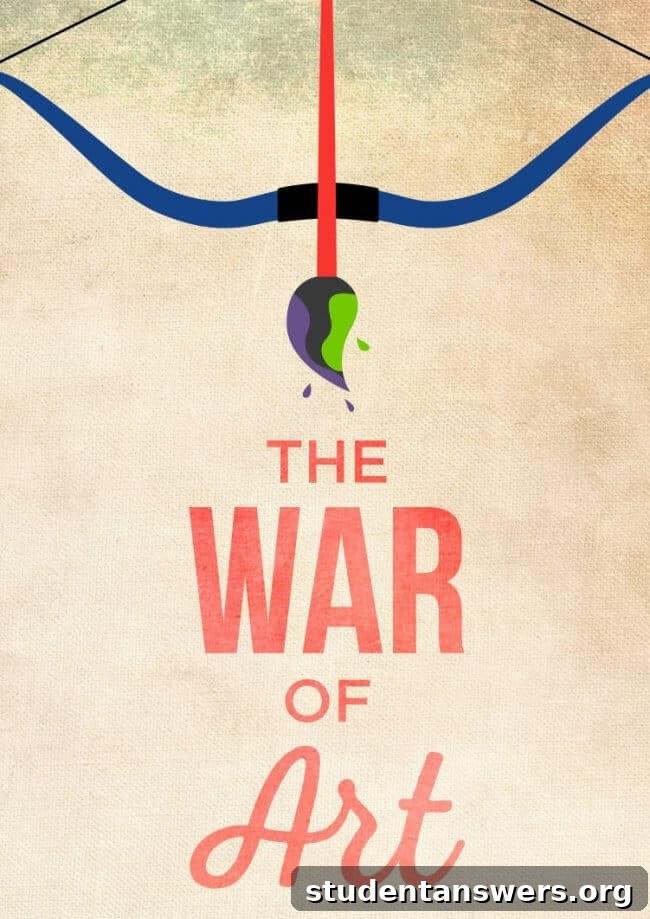
Resources Mentioned in This Article:
- The War of Art: Break Through the Blocks and Win Your Inner Creative Battles, by Steven Pressfield
- A Deeper Analysis of Pressfield’s Philosophy
- Practical Guide to Beating Procrastination by James Clear
If you found this discussion helpful, please consider sharing it with someone who might be fighting their own battle with Resistance. The first step to victory is knowing you’re not alone in the fight.