
How to Become an Irresistible Job Candidate: 5 Actionable Strategies
In today’s competitive job market, simply having the right qualifications on paper isn’t enough. You might be the most skilled programmer, the most knowledgeable historian, or a brilliant financial analyst, but if you can’t effectively communicate that value to a potential employer, your application can easily get lost in a sea of resumes. The key to landing your dream job or internship isn’t just about what you know; it’s about how you present it. It’s about making yourself an unforgettable, irresistible candidate.
Standing out requires a strategic approach. Your talent and raw experience are the foundation, but other factors play a crucial role in building a compelling professional profile. It’s about creating a personal brand that is impossible for recruiters to overlook.
This guide will detail five powerful strategies you can implement today to transform yourself into a top-tier applicant. These aren’t abstract theories; they are concrete actions that will set you apart. The goal is to move beyond just reading and to start doing. Challenge yourself to begin implementing at least one of these steps right now and watch your professional opportunities expand.
1. Craft a Tailored Resume and Seek Expert Feedback
Almost every job applicant has a resume, but very few use it to its full potential. Many see it as a simple historical record—a list of jobs, education, and skills. To be truly effective, however, your resume must be a dynamic, forward-facing marketing document specifically designed to secure the job you want.
Tailor Your Resume for Every Application
One of the most common mistakes is using a single, generic resume for every job application. Your resume should be job-specific. The version you submit for a marketing internship should highlight different experiences and skills than the one you use for a data analysis position. Always feature your most relevant experience prominently at the top.
For example, if you are applying for a software development role, your coding projects and technical internships should be listed before your part-time job as a barista. The only exception is if a less relevant position is significantly more prestigious. An internship at a globally recognized company like Google or NASA, for instance, carries immense weight and should be featured prominently, as it immediately captures a recruiter’s attention.
If you are just starting your career and have limited experience, it’s acceptable to list all your work. However, as you gain more experience, tailoring becomes essential for showcasing your suitability for each unique role.
Focus on Accomplishments, Not Just Duties
Another critical step is to frame your experience in terms of accomplishments rather than mere responsibilities. Instead of listing what you were supposed to do, describe what you actually achieved. Use quantifiable metrics whenever possible to demonstrate your impact. For instance:
- Instead of: “Managed the company’s social media accounts.”
- Try: “Grew social media engagement by 35% over six months by implementing a new content strategy and A/B testing post formats.”
This approach transforms your resume from a passive list into a powerful story of your professional contributions and successes. Use strong action verbs to start each bullet point, such as “developed,” “optimized,” “led,” “analyzed,” and “created.”
Get Your Resume Critiqued
Even a well-crafted resume can benefit from a fresh pair of eyes. Most colleges and universities have career services offices that offer free resume critiques. These professionals have seen thousands of resumes and know what recruiters in various industries are looking for. They can provide invaluable feedback on formatting, wording, and overall effectiveness. Taking advantage of this resource can reveal blind spots and help you polish your resume to perfection.
2. Build a Professional Personal Website
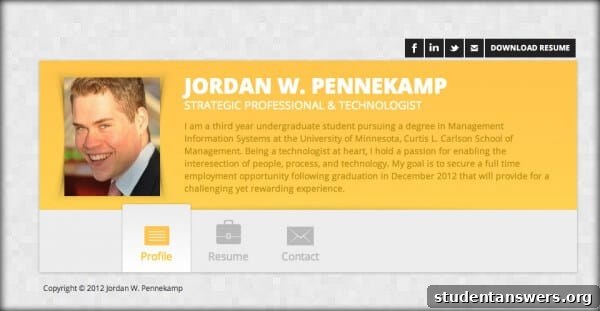
A polished resume is your foundational requirement, but it’s a static document. In the digital age, you can create a much more dynamic and comprehensive professional presence with a personal website. A website serves as your central hub online, a space you completely control where you can showcase your work, personality, and expertise in ways a single piece of paper never could.
Having a personal website with a URL like www.yourname.com on your resume and LinkedIn profile instantly makes you stand out. It signals a high level of professionalism, technical savvy, and a genuine investment in your career. It demonstrates that you are not just a passive job seeker but an active participant in your professional field.
You don’t need to be a coding expert to build an impressive site. Platforms like WordPress, Squarespace, and Wix offer user-friendly interfaces and professional templates that allow you to create a beautiful website in just a few hours. Your site should include key sections:
- Home Page: A brief, compelling introduction to who you are and what you do.
- About Me: A more detailed narrative about your background, passions, and career goals.
- Portfolio: A dedicated section to showcase your best work (more on this in point 5).
- Resume: An online version of your resume or a link to a downloadable PDF.
- Contact: A simple form or professional email address for people to get in touch.
Your personal website is your digital business card, portfolio, and personal brand headquarters all in one. It’s one of the most powerful tools you can use to control your online narrative and impress potential employers.
3. Design and Utilize Professional Business Cards
While some argue that physical business cards are obsolete in an era of smartphones and LinkedIn, they remain a powerful networking tool. The purpose of a business card today is less about the simple transfer of contact information and more about making a memorable, professional impression.
When you attend a career fair, conference, or networking event, handing someone a well-designed business card elevates the interaction. It shows you are prepared, serious about your career, and organized. It provides a tangible reminder of your conversation and makes it easy for a recruiter or contact to follow up with you later.
A common mistake is to create a card that feels cheap or unprofessional. Your card is a reflection of your personal brand. Avoid flimsy paper and generic templates. Instead, opt for a clean, modern design that is easy to read. You can use online services like Canva to create a professional design without needing graphic design skills. Your business card should include essential information:
- Your Full Name
- Your Title or Field (e.g., “Aspiring Marketing Professional,” “Computer Science Student”)
- A Professional Email Address
- Phone Number (Optional)
- Your Personal Website URL
- Your LinkedIn Profile URL
Having a business card ready to share demonstrates foresight and professionalism, helping you stand out from the crowd and leave a lasting positive impression.
4. Develop Your Communication Skills
You can have the most impressive resume, website, and portfolio in the world, but if you cannot communicate effectively, your efforts may be wasted. Strong communication skills are consistently ranked by employers as one of the most critical attributes in a candidate. This encompasses your ability to write clearly, speak confidently, and listen actively.
Master Written Communication
From the first email you send to a recruiter to your follow-up note after an interview, your writing is constantly being evaluated. Ensure all your written correspondence is professional, concise, and free of grammatical errors. Respect the other person’s time by getting to the point quickly and clearly. Learn the proper etiquette for professional emails, cover letters, and other written communications.
Practice Public Speaking
Many people fear public speaking, but it is an essential skill for career success. Whether you are presenting in a team meeting, pitching an idea, or answering questions in an interview, your ability to speak with confidence and clarity is crucial. Take a public speaking class in college, even if it’s not required. Practice speaking about your projects and experiences so that you can articulate your thoughts clearly and persuasively when the opportunity arises.
Become an Active Listener
Communication is a two-way street. Being an effective communicator also means being an excellent listener. During interviews and networking conversations, pay close attention to what the other person is saying. Formulate responses that show you are engaged and have understood their points. Active listening helps you build rapport and leaves the impression that you are thoughtful and considerate.
5. Curate a Portfolio of Your Best Work
A resume tells people what you’ve done; a portfolio shows them. Creating a portfolio of your best work is perhaps the most direct way to prove your skills and capabilities. Instead of letting your best projects collect digital dust on a hard drive, gather them into an organized collection that you can easily share with potential employers.
An online portfolio is the most effective format, as it is accessible from anywhere. The best place for your portfolio is on your personal website, creating a seamless experience for anyone looking to learn more about you. Your portfolio should be a curated showcase, not an exhaustive archive. Select a few of your strongest projects that best demonstrate the skills relevant to the jobs you are targeting.
Your portfolio can include a wide variety of work depending on your field:
- For designers: Graphic designs, UI/UX projects, illustrations.
- For writers: Articles, essays, creative writing samples, or marketing copy.
- For programmers: Links to GitHub repositories, descriptions of software projects, or live demos of applications you’ve built.
- For business students: Case study analyses, market research reports, or business plans you’ve developed.
For each project, include a brief description that explains the context, the problem you were solving, your specific role, and the outcome. A strong portfolio provides concrete evidence of your abilities and makes it easy for an employer to envision you succeeding in their organization.
Take Action and Transform Your Career Prospects
Becoming an irresistible candidate doesn’t happen by accident. It is the result of deliberate and consistent effort. The five strategies outlined here—tailoring your resume, building a personal website, using business cards, honing your communication skills, and creating a portfolio—will make you significantly more hirable.
You now have a clear roadmap. The next step is to take action. You don’t have to do everything at once. Start with one: get your resume critiqued this week. Spend a weekend building the first version of your personal website. By taking these concrete steps, you will move from being just another applicant to becoming a candidate that companies are excited to hire.