

Cambridge Triumphs in Varsity Poker Clash

Cambridge Claims Victory in the Prestigious Varsity Poker Match Against Oxford

In a battle of wits, strategy, and psychological fortitude, Cambridge University has emerged victorious over its historic rival, Oxford, in the newly relaunched Varsity Poker Match. This high-stakes intellectual showdown, now sponsored by Full Tilt Poker, marks a significant moment for university poker, with hopes high that this will become a celebrated annual event, adding a new dimension to the centuries-old Oxbridge rivalry.
A New Chapter in an Ancient Rivalry
The rivalry between Cambridge and Oxford is the stuff of legend, traditionally fought on the River Thames in the Boat Race and on the rugby pitch. Now, this storied competition has found a new arena: the poker table. The relaunch of the Varsity Poker Match signifies the growing recognition of poker not merely as a game of chance, but as a complex mind sport that demands analytical prowess, mathematical calculation, and keen psychological insight—skills honed in the lecture halls and libraries of these elite institutions.
The event was masterfully organized by the Cambridge University Poker Society, which, now in its 12th year, has been instrumental in cultivating a thriving poker scene on campus. The society’s efforts have helped shift the perception of the game away from outdated, smoke-filled backroom clichés to that of a sophisticated and competitive endeavor. The formalization of the Varsity Match, held just a day before the well-established Oxford Cup, solidifies poker’s place in the university events calendar and provides a platform for the brightest young minds to test their mettle.
The Mechanics of the Match: A Deep Dive into Texas Hold’em
The format of the Varsity Match was designed to test both individual skill and team strategy. The chosen game was No-Limit Texas Hold’em, the most popular and strategically deep variant of poker worldwide. The competition began with a series of heads-up (one-on-one) matches between players from each university. The outcome of these initial duels determined the starting chip stacks for the grand finale: a multi-table tournament.
In Texas Hold’em, the objective is to win the “pot” – the sum of all bets made in a hand – by either having the best five-card hand or by convincing all other players to fold. The game unfolds in distinct stages:
- The Pre-Flop: Each player is dealt two private cards, known as “hole cards.” A round of betting ensues, based on the strength of these initial cards.
- The Flop: Three community cards are dealt face-up in the center of the table. These are shared by all players. Another round of betting occurs.
- The Turn: A fourth community card is dealt, followed by another betting round. This is where hands can dramatically change, and the pressure intensifies.
- The River: The fifth and final community card is revealed. A final round of betting takes place before the “showdown,” where remaining players reveal their hands to determine the winner.
The ultimate goal for each team in the Varsity tournament was simple but ruthless: to be the last team standing. Victory was achieved by systematically eliminating every single player from the opposing university, making every decision and every chip crucial to the final outcome.
Beyond the Cards: Poker as a Mind Sport
The spectacle of Cambridge and Oxford students battling over the felt table serves as a powerful illustration of the intellectual rigor required to excel at poker. Success in this game is a delicate balance of art and science, demanding a unique blend of quantitative analysis and qualitative judgment.
The Mathematical Edge
At its core, poker is a game of incomplete information and probability. Players must constantly perform complex mental calculations to make optimal decisions. This includes calculating “pot odds” (the ratio of the current size of the pot to the cost of a contemplated call) and “equity” (the percentage chance of winning the hand). Students accustomed to solving complex equations and analyzing data sets find a natural application for their skills, determining whether a bet is profitable in the long run. Understanding concepts like implied odds and reverse implied odds further separates the skilled player from the casual gambler.
The Psychological Game
Beyond the numbers, poker is a profound psychological contest. It involves reading opponents’ betting patterns, physical tells, and timing to deduce the strength of their hand. The art of the bluff—betting aggressively with a weak hand to force a better hand to fold—is a cornerstone of high-level play. Equally important is emotional discipline. A player must remain calm under pressure, avoid “going on tilt” (playing emotionally and recklessly after a bad beat), and maintain focus for hours on end. These psychological skills are invaluable, mirroring the resilience and strategic thinking required in high-pressure academic and professional environments.
The Final Showdown: How Cambridge Secured the Win
From the outset of the match, held at the Oxford Student Union, Cambridge demonstrated a commanding presence. The initial heads-up rounds concluded with the light blues of Cambridge securing a significant 20–16 chip lead over their dark blue rivals. This early advantage proved to be a decisive factor as the players converged for the final tournament rounds.
The Cambridge team leveraged their chip lead with calculated aggression, putting immense pressure on the Oxford players. One by one, the Oxford contingent fell, until only Yousisif Moneimne, a PPE student, remained to fight for his university’s honor. Despite a valiant effort on home turf, Moneimne faced an overwhelming challenge against the remaining Cambridge players. The numbers game was too much to overcome, and the Cambridge team methodically closed out the game, ensuring their victory.
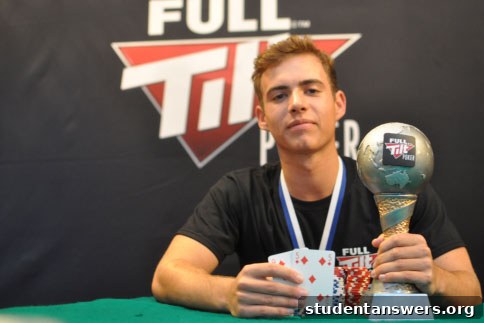
Victorious Cambridge University Captain Mark Hammond with the Varsity Poker Match trophy
Leading his team to this historic win was Cambridge University’s Captain and President of the Poker Society, Mark Hammond. His leadership and skill were evident as he was among the final players to secure the trophy for his university. His Oxford counterpart, Captain Gabriel Tiplady, was gracious in defeat, acknowledging the excellent level of competition and celebrating the fact that the special and unique rivalry now had a new, exciting front.
The Future of University Poker
The success of the 2014 Varsity Poker Match has laid a strong foundation for the future. The event not only showcased the incredible talent within these universities but also highlighted poker’s legitimacy as a competitive mind sport. With a major sponsor and renewed interest, the path is clear for this to become an unmissable annual fixture, inspiring more students to engage with the game strategically and analytically.
Meanwhile, the Oxford Cup, held the following day, continued to demonstrate the region’s passion for the game. Oxford’s own Rick Hawkins triumphed over a large field of 153 players, claiming the lion’s share of the £4,500 prize pool. Together, these two events signal a bright future for university poker, where the next generation of leaders and thinkers can sharpen their minds, test their courage, and perhaps, bluff their way to victory.