

The world of digital marketing is a vast and rapidly expanding career field. As our lives become increasingly intertwined with the internet, companies of all sizes are desperately seeking skilled marketers. They need professionals who can navigate the complexities of social media, analyze data, manage advertising campaigns, and build effective sales funnels.
If you can develop expertise in these areas, you’ll unlock a wealth of high-paying job opportunities. The best part? You don’t need a traditional four-year college degree to learn these valuable skills and launch a successful career. This guide is your comprehensive starting point for breaking into the exciting field of digital marketing.
Why You Should Launch a Career in Digital Marketing Today
What makes digital marketing such an attractive and future-proof career path? While the reasons are numerous, here are six of the most compelling advantages that set this field apart.
1. Digital Marketing Roles Are in Extremely High Demand
When searching for a stable and rewarding career, the basic economic principle of supply and demand is your best friend. Ideally, you want to enter a field where the demand for skilled professionals far outweighs the available supply. Digital marketing is a prime example of this scenario. When companies are competing to hire from a limited pool of qualified candidates, they are more willing to offer competitive salaries and invest in your growth.
A quick search on major job boards like Indeed or LinkedIn for terms like “digital marketer” or “SEO specialist” will reveal tens of thousands of open positions at any given time. This staggering number demonstrates the immense and ongoing need for people with digital skills. While there are many online courses and programs, a significant skills gap remains; few produce graduates with the practical, hands-on knowledge that modern companies require. This gap presents a massive opportunity for anyone willing to put in the effort to learn and apply these skills.
2. Competitive Salaries, Even at the Entry-Level
While passion for your work is important, financial compensation is a critical factor in any career choice. The digital marketing industry offers impressive salaries, especially considering that many roles do not require a college degree. It’s a field where demonstrable skills and results often speak louder than formal credentials.
According to data from job sites like Glassdoor and Indeed, the average salary for a digital marketer in the United States is well above the national average, often starting in the $60,000 range and climbing rapidly with experience. Of course, salaries vary based on location, specialization (like SEO or paid ads), and experience level. However, the potential for a six-figure income within a few years is a realistic goal for dedicated and skilled professionals in this field.
3. Work for Innovative and Exciting Companies
Forget the stereotype of a monotonous entry-level job in a gray cubicle. The digital marketing world is filled with dynamic, forward-thinking companies. From vibrant tech startups to creative marketing agencies, you’ll find work environments that are a far cry from the traditional corporate mold.
Many companies in this space pride themselves on fostering a positive and engaging work culture. It’s not uncommon to find offices that are dog-friendly, offer flexible work hours, and boast perks like free lunches, wellness stipends, and continuous education budgets. For example, leading tech companies often provide their teams with monthly allowances for books, courses, and even coffee shop visits to encourage creativity and professional development. If you’re seeking a work culture that values innovation and employee well-being, digital marketing is an excellent place to look.
4. Unmatched Flexibility and Remote Work Opportunities
This benefit is so significant it deserves its own spotlight. Because the work is inherently digital, marketing roles are perfectly suited for flexible and remote arrangements. This was a growing trend even before 2020, and it has since become a standard expectation in the industry.
Many tech-savvy companies offer their digital marketing teams the freedom to work from anywhere in the world. This location independence is a life-changing benefit for many. Even if a role isn’t 100% remote, you’ll often find hybrid models or flexible schedules that allow for a much better work-life balance than a traditional 9-to-5 job. Policies like unlimited paid time off (PTO) are also becoming more common, giving you more control over your time and life.
5. Abundant Opportunities for Freelancing and Entrepreneurship
While this guide focuses on landing a full-time job, the skills you acquire in digital marketing open the door to incredible freelance and entrepreneurial ventures. Once you have a foundation of experience, perhaps from working at an agency or in-house, you can easily transition to building your own business.
With strong digital marketing and basic sales skills, you can build a roster of clients and potentially earn more than you would in a full-time position, all on your own terms. Freelancing allows you to set your own hours, choose the projects you’re passionate about, and scale your income. You could even structure your work to take several months off each year to travel, pursue hobbies, or work on other passion projects.
6. The Skills Are Accessible and Self-Taught
Many high-paying professions require years of expensive university education, apprenticeships, or lengthy certification programs. Digital marketing breaks this mold. It is one of the most accessible and meritocratic fields you can enter, as nearly everything you need to know can be learned on your own.
The tools of the trade are often free or have low-cost entry points. You don’t need to invest in expensive software or equipment to get started. Furthermore, the internet is a treasure trove of high-quality information. From industry blogs and YouTube tutorials to official documentation from Google and Meta, you can build a solid foundation of knowledge entirely for free. Affordable, structured online courses can then help you accelerate your learning and fill in any gaps.
The Core Skills to Land Your First Digital Marketing Job
Are you convinced that a career in digital marketing is right for you? Fantastic. Now let’s tackle the part that often feels the most daunting: acquiring the necessary skills and experience. Job descriptions can be filled with acronyms and technical jargon like SEO, PPC, CTR, and GA4. Don’t let this intimidate you.
Your goal is not to become an expert in everything overnight. Your goal is to learn just enough to understand the fundamentals, use the core tools, and speak intelligently about the field. Here are the essential skills and concepts you need to master to land an entry-level position.
0. Grasp the Fundamentals of Marketing
Before diving into specific digital tools, you must understand the core purpose of marketing. At its heart, marketing is the process of making people aware of a product or service and guiding them toward a purchase. Digital marketing simply uses online channels and tools to achieve this goal. Let’s define some key terms you’ll encounter constantly.
6 Essential Marketing Terms You Must Know
1. Traffic – In the digital world, traffic refers to the number of visitors to a website or specific web page over a period of time. It’s the digital equivalent of foot traffic in a physical store and the first step in any online business process.
2. Conversion – Traffic is important, but conversions are what truly drive business success. A conversion is when a visitor takes a desired action. This could be making a purchase, signing up for a newsletter, downloading a guide, or filling out a contact form.
3. Conversion Rate – This is a critical metric that measures the effectiveness of your marketing. It’s the percentage of visitors who complete a desired action (convert). To calculate it, you divide the number of conversions by the total number of visitors and multiply by 100. For example, if 50 out of 2,000 visitors make a purchase, your conversion rate is (50 / 2,000) * 100 = 2.5%.
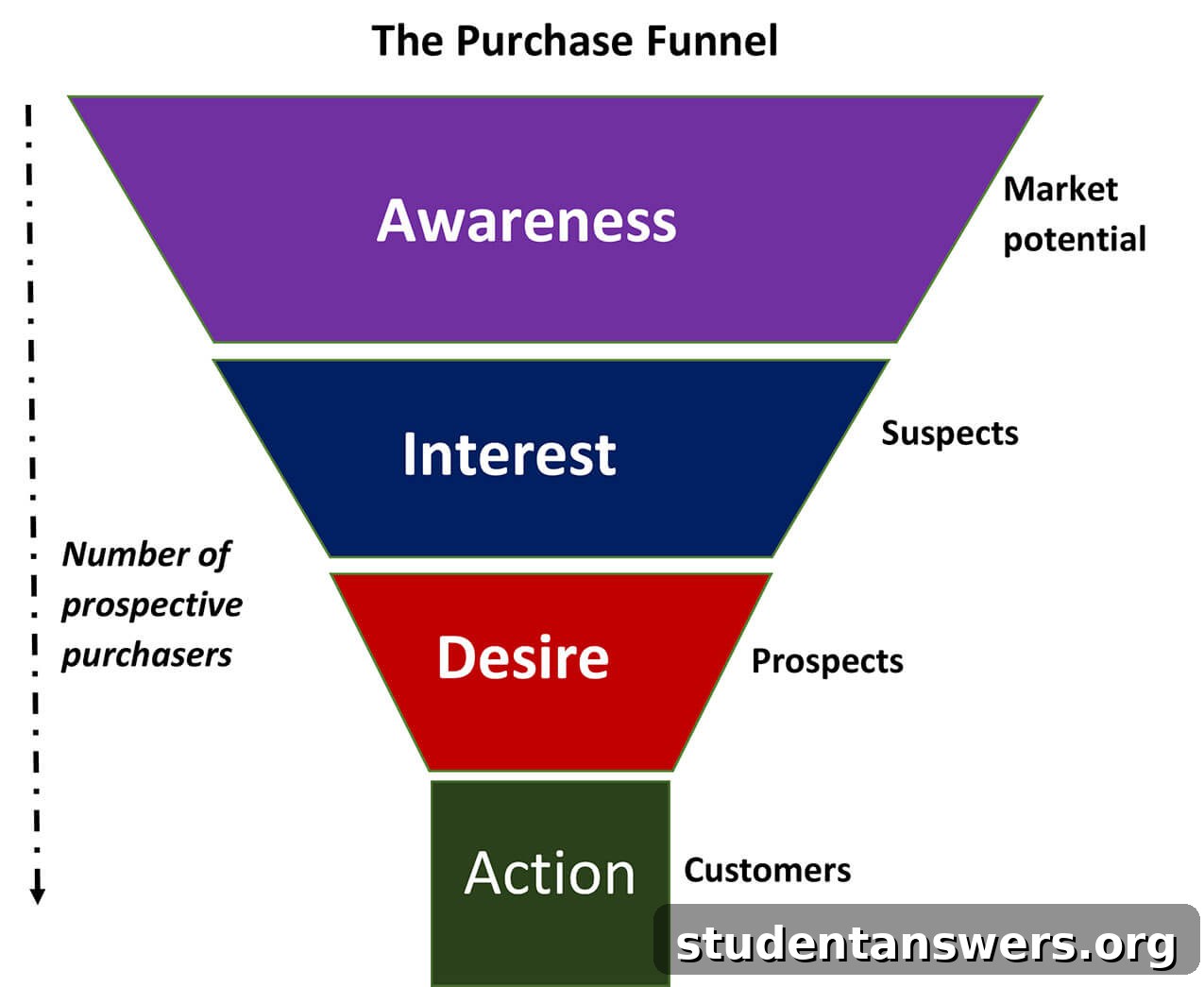
4. Sales Funnel – A funnel is a model that visualizes the journey a customer takes from initial awareness to making a purchase. It’s typically broken into stages: Top of Funnel (Awareness), Middle of Funnel (Consideration), and Bottom of Funnel (Decision/Purchase). Understanding the funnel helps marketers create targeted content and campaigns for each stage.
5. Customer Lifetime Value (CLV) – This metric predicts the total net profit a company can expect to earn from a single customer over the entire duration of their relationship. CLV helps businesses make strategic decisions about how much to invest in acquiring new customers and retaining existing ones.
6. Customer Acquisition Cost (CAC) – This is the total cost of sales and marketing efforts required to acquire a new customer. You calculate it by dividing your total marketing expenses by the number of new customers acquired in a specific period. A sustainable business model requires that a customer’s CLV is significantly higher than their CAC.
With these foundational concepts in mind, let’s explore the five core technical skills that are valuable in nearly every digital marketing role.
1. Website Management Fundamentals
Nearly all digital marketing activities—from ads to social media posts to emails—are designed to drive traffic to a website. Therefore, a fundamental understanding of how websites work is non-negotiable. The best way to learn this is by building your own simple website. This hands-on project will teach you about domains, hosting, and Content Management Systems (CMS) like WordPress. It also provides you with a personal online space—a digital sandbox—where you can practice and showcase all the other skills on this list.
2. Paid Advertising (PPC)
Paid advertising, often called Pay-Per-Click (PPC), is where a significant portion of marketing budgets are spent. It’s the art and science of placing ads on platforms to drive immediate, targeted traffic. The two dominant platforms you must learn are Google Ads and Meta Ads (Facebook & Instagram). Google Ads is powerful for capturing user intent through search results, while Meta Ads excels at targeting users based on their demographics and interests. Start by taking the free, official training courses offered by Google (Skillshop) and Meta (Blueprint) to learn the fundamentals of campaign creation, targeting, and analysis.
3. Web Analytics with Google Analytics
Marketing without data is just guessing. Google Analytics is the industry-standard tool for measuring and understanding website traffic. It provides an incredible amount of data about your visitors: how they found your site, which pages they visit, how long they stay, and where they are located. Learning to install and navigate Google Analytics is a crucial skill. It allows you to track the performance of your marketing campaigns, make data-driven decisions, and prove the value of your work. The best place to start is the free Google Analytics Academy.
4. Search Engine Optimization (SEO)
While paid ads deliver immediate results, they can be expensive. SEO is the practice of optimizing your website and content to rank higher in organic (non-paid) search engine results on platforms like Google. This is the key to generating sustainable, long-term, and “free” traffic. SEO is broadly divided into three areas:
- On-Page SEO: Optimizing individual pages with relevant keywords, high-quality content, and clear meta descriptions.
- Off-Page SEO: Building authority and trust through backlinks from other reputable websites.
- Technical SEO: Ensuring your website is fast, mobile-friendly, and easy for search engines to crawl and index.
Start by learning keyword research using free tools like Google Keyword Planner. Then, practice writing content for your personal website that targets those keywords and provides genuine value to readers.
5. Email Marketing
Some may call it old-fashioned, but email marketing consistently delivers one of the highest returns on investment (ROI) of any marketing channel. It’s a direct line of communication to an audience that has opted-in to hear from you. Key skills include building an email list (using lead magnets), writing compelling email copy, segmenting your audience for targeted messaging, and using email automation software like MailChimp or ConvertKit. You can start by adding a simple subscription form to your personal website and practicing sending regular updates to your small list.
6. Social Media Marketing (SMM)
This skill goes far beyond simply knowing how to post on Facebook or Instagram. Professional social media marketing involves creating a content strategy that aligns with business goals, such as building brand awareness, fostering a community, or even driving direct sales. It requires an understanding of each platform’s unique audience and algorithm. You’ll need to learn how to create engaging content (text, images, and video), manage a content calendar, and analyze performance metrics. Start by creating professional-style accounts for your personal brand and experimenting with different types of content to see what resonates and grows your following.
How to Gain a Crucial Edge with Real-World Experience
Skills are essential, but employers almost always look for experience. This creates the classic “experience paradox”: you can’t get a job without experience, but you can’t get experience without a job. Here’s how to break that cycle and stand out from other applicants.
1. Prioritize Learning Over Earning at First
Your first marketing gig might not be glamorous or high-paying. It could be a part-time internship or a short-term contract job. It’s crucial to see these opportunities not just for their paycheck, but for what they truly are: a paid education. The hands-on experience you gain, even in a junior role, is invaluable. It provides you with real-world case studies and results that you can add to your resume and talk about in future interviews. This experience is the currency that will unlock higher-paying jobs down the line.
2. Offer Your Skills to Local and Small Businesses
If you’re struggling to land a formal role, create your own experience. Look around your community. The local coffee shop, the family-owned restaurant, the neighborhood plumber—chances are their online presence is outdated or non-existent. Their websites may be poorly designed, or they may have no social media presence at all. Approach them with a simple, professional proposal. Offer to help them improve their local SEO, set up a simple Facebook page, or run a small ad campaign, perhaps for a very low fee or even for free in exchange for a testimonial. This is a fantastic way to build a portfolio of real work with measurable results.
3. Leverage Your Personal and Professional Network
Don’t underestimate the power of your existing network. Let your friends, family, and former colleagues know that you are developing skills in digital marketing and looking for opportunities. Use LinkedIn to see where people in your network work. Ask for introductions to the marketing managers at their companies. Even if it doesn’t lead to a job immediately, these informational interviews are a great way to practice your pitch, get advice from industry professionals, and build connections that could lead to future opportunities.
Fast-Track Your Path to a Digital Marketing Career
This guide provides a comprehensive roadmap for starting your journey in digital marketing. By following these steps, you can absolutely teach yourself the necessary skills and land a great job. However, self-learning can sometimes be slow and unstructured, especially if you’re trying to make a career change quickly.
If you’re looking to accelerate your progress, consider investing in a structured, high-quality online course or digital marketing bootcamp. These programs provide a curated curriculum, expert guidance, and access to a community of peers and mentors. This can be incredibly valuable for staying motivated and getting your questions answered quickly. While there are many free resources, a well-designed paid course can be a worthwhile investment in your future, condensing months or years of self-study into a more focused and efficient learning path.
Whether you choose a self-taught route or a structured program, the opportunities in digital marketing are immense. With dedication and a focus on building practical skills, you can be well on your way to a lucrative, flexible, and fulfilling career that is at the forefront of the modern economy.