

Channeling Your Creative Chaos into Focused Action

How to Focus When You Have Too Many Interests: A Guide to Prioritization
Do you ever feel pulled in a dozen different directions at once? One day you’re determined to learn the piano, the next you’re researching how to start a podcast. You walk into a bookstore and feel an overwhelming urge to visit every single section—from world history and science to graphic novels and biographies. Your professional life is no different, with a constant stream of new project ideas and skills you want to acquire.
If this sounds familiar, you are not alone. This feeling of being stuck, pulled by countless passions without making significant progress in any single one, is a common struggle in our modern world. We are living in an era of unprecedented opportunity, where information is abundant and new paths are always presenting themselves. While this is a gift, it can also be a curse.
This phenomenon is often described as the “paradox of choice.” It’s the idea that while we believe more options lead to better outcomes and greater satisfaction, the opposite is often true. An excess of choice can lead to anxiety, indecision, and a state of paralysis where we fail to commit to anything at all. As Sheena Iyengar, a professor at Columbia Business School, expertly noted, the overwhelming number of options can even lead us to make poor decisions, such as delaying saving for retirement simply because there are too many funds to choose from.
The reality is, this abundance of choice isn’t going away. So, how can we navigate this landscape of endless possibilities? How do you narrow down your interests, select your priorities, and dedicate enough focus to make meaningful progress? This guide will explore two powerful strategies to help you conquer the chaos and find your focus.

The Warren Buffett 2-List Strategy for Ruthless Prioritization
There’s a popular story, often attributed to billionaire investor Warren Buffett, that offers a brilliant framework for cutting through the noise. As detailed by author James Clear, the story involves a conversation between Buffett and his personal pilot, who was struggling to define his career priorities.
To help him gain clarity, Buffett walked him through a simple yet profound three-step exercise.
Step 1: Identify Your Goals
First, Buffett asked the pilot to write down his top 25 career goals. These could be anything he wanted to accomplish in his life, both big and small. This initial step is about brainstorming without judgment, getting every aspiration out of your head and onto paper.
Step 2: Circle Your Top Five Priorities
Next, Buffett instructed him to review the list carefully and circle the five most important goals. These weren’t just interesting ideas; they were the absolute, non-negotiable top priorities that would have the most significant impact on his life. This forces a difficult but necessary process of evaluation, creating a clear hierarchy among your ambitions.
At this point, the pilot had two lists: List A, containing his five critical goals, and List B, containing the other 20 interesting but less crucial goals.
Step 3: Avoid List B at All Costs
When Buffett asked what he planned to do with the 20 items on List B, the pilot logically replied that he would work on them intermittently, giving them attention when he had spare time, while keeping his main focus on List A. Buffett’s response was stern and immediate: “No. You’ve got it wrong.”
He explained that the 20 items on List B were not a secondary priority list. They were his Avoid-at-All-Costs List. These goals were to receive zero time or energy until he had successfully achieved his top five.
While the authenticity of this story is debated, the wisdom it contains is undeniable. The greatest threat to your most important goals isn’t laziness or a lack of ambition; it’s the allure of your “good” ideas. The items on List B are dangerous precisely because they are still appealing. They are interesting and worthwhile, making them the most likely distractions to pull you away from the truly essential. To make real progress, you must be willing to ruthlessly eliminate them from your focus.
A Modern Approach: The “Now” Page Movement
The Buffett strategy is an excellent mental exercise for gaining clarity, but how do you maintain that focus day-to-day? An elegant and practical solution has emerged from the work of Derek Sivers, an entrepreneur, writer, and founder of CD Baby.
Sivers created a simple page on his website titled “What I’m Doing Now.” The page is exactly what it sounds like: a short, public declaration of his current priorities. It clearly states what projects and activities are consuming his attention and explicitly notes that because of this focus, he is not taking on other opportunities.
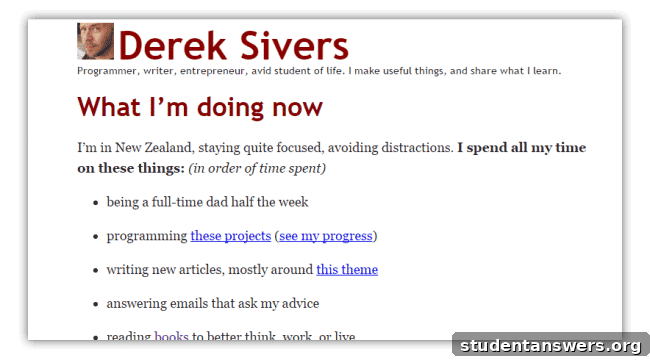
This simple concept is powerful for several reasons:
- It Provides a Filter for Saying “No”: Having a public statement of your priorities makes it easier to decline requests and opportunities that don’t align with your current goals. It externalizes the decision, turning “I don’t want to” into “I can’t, because I’m committed to these other things.”
- It Serves as a Constant Personal Reminder: A “Now” page acts as your North Star. Whenever you feel your focus drifting or are tempted by a new, shiny object, you can return to your page to re-center yourself on what truly matters right now.
- It Manages Others’ Expectations: It communicates to your network, colleagues, and potential collaborators what you’re working on, preventing misunderstandings and irrelevant pitches.
Adapting the “Now” Page to Your Own Life
Inspired by this idea, I created my own “Now” page, but with one key difference. Derek Sivers’ page is quite absolute, stating: “I say no to all requests, because I just need to focus on my work.”
As someone earlier in my career who values novelty and spontaneity, that felt too restrictive. My approach is slightly more flexible:
“I am open to considering new opportunities, as I highly value novelty, spontaneity, and growth. However, I aspire to stick to my priorities 90% of the time. As a result, I will say no to the majority of requests that come my way now.”
This framing allows for serendipity while still committing to a strong default of focus. Your level of strictness can and should depend on your current “season” of life. If you’re in an exploratory phase, you might be more open. If you’re deep in a major project, like writing a book or launching a company, a more rigid approach like Sivers’ might be necessary.
Create Your Own “Now” Page Today
If you feel overwhelmed by your many interests, creating a “Now” page could be a transformative step. It doesn’t need to be complicated or hosted on a fancy website. You can simply write it in a document and pin it to your wall or desktop.
Here’s how to get started:
- Brainstorm Your Priorities: Start with the Buffett exercise. List out everything you’re interested in doing or achieving.
- Select Your Current Focus: Choose the 3-5 things that are most important for you to work on *right now*. This isn’t a life sentence; it’s a declaration of your focus for this current season. Be realistic about what you can truly dedicate your energy to.
- Write Your Page: In clear and simple language, list your priorities. You might also include a brief statement about your philosophy on new opportunities, like the examples above.
- Make It Visible: The key is to keep this document somewhere you will see it regularly. Put it on your personal website, in a pinned note, or on a physical piece of paper above your desk.
By defining and declaring your priorities, you create a powerful defense against distraction. You give yourself a clear roadmap for your daily decisions, making it easier to stay on track and build momentum. Find your focus, plan your days with intention, and watch as you begin to make meaningful progress on the goals that matter most.