
How to Write the Perfect Resume: Your Ultimate Guide to Landing the Job
Let’s be honest: nobody enjoys writing a resume. It can feel like a strange exercise in boasting, trying to cram years of your life onto a single page. The pressure is immense. You have to distill your skills, experiences, and accomplishments into a document that convinces a complete stranger to give you a chance, and hopefully, a paycheck.
Faced with this daunting task, it’s tempting to find a generic online template, plug in a few facts, and hope for the best. But that approach rarely gets you noticed. Your resume is often the very first impression you make on a potential employer, and you want it to be a great one.
While we can’t promise to make resume writing fun, we can make it a clear, strategic, and painless process. This comprehensive guide will walk you through everything you need to know. We’ll show you how to craft a compelling resume that cuts through the noise, highlights your unique value, and gets you that interview. Let’s build the document that opens the door to your next big opportunity.
What Is a Resume and Why Does It Still Matter?
The concept of a resume is so ingrained in our professional lives that it’s easy to assume it has always existed. The word itself comes from the French résumé, meaning “summary.” In that sense, the first-ever resume might have been a letter written by Leonardo da Vinci in the 1480s to a potential patron, outlining his many skills in engineering and art.
However, the modern, professionally formatted resume is a product of the 20th century. Before then, job applications were often informal, sometimes including personal details like height, weight, and marital status—information that is now considered inappropriate and discriminatory. Today, a resume is a concise, professional summary of your qualifications for a specific role.
But in an age of LinkedIn profiles and personal websites, does a traditional resume still hold weight? The answer is a resounding yes. While a strong online presence is crucial, the resume remains a cornerstone of the application process for two key reasons:
- It Provides a Quick, Scannable Summary: Hiring managers are busy. They often receive hundreds of applications for a single opening. A well-structured resume allows them to quickly assess your qualifications, experience, and education to see if you meet the basic requirements. It’s their first filter to narrow down the candidate pool.
- It Demonstrates Your Professionalism and Communication Skills: Your resume is more than just a list of facts; it’s a sample of your work. A document that is clear, concise, well-organized, and free of errors shows that you are detail-oriented, professional, and a capable communicator. Conversely, a sloppy resume can get you disqualified before you even get a chance to prove yourself.
The Core Anatomy of a Winning Resume: 5 Essential Sections
Every effective resume is built upon a few key sections. While you can customize the order based on your experience level and industry, these five components form the foundation of a document that will impress any recruiter.
1. Work Experience: Show, Don’t Just Tell
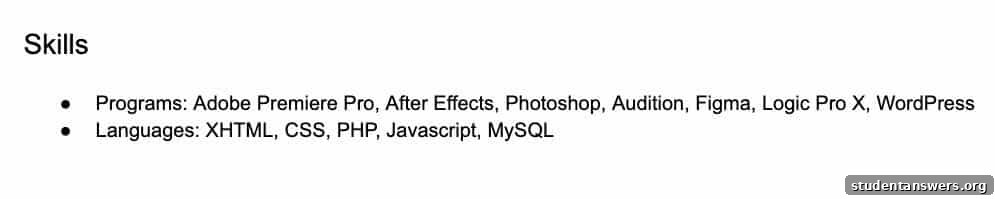
This is arguably the most important section of your resume. It’s where you prove you have the skills and background to succeed in the role. When listing your experience, follow this standard format for clarity:
- Company Name
- Company Location (City, State)
- Your Job Title
- Employment Dates (Month, Year – Month, Year)
- A few bullet points detailing your accomplishments
The biggest mistake people make here is simply listing their job duties. A recruiter already knows what a “Sales Associate” or “Project Intern” generally does. What they want to know is what you achieved. Instead of describing your responsibilities, highlight your accomplishments. The best way to do this is to quantify your results with numbers.
For example, instead of saying:
- “Managed the company’s social media accounts.”
Try something more impactful:
- “Grew the company’s Instagram following by 40% over six months by implementing a new content strategy and engaging with followers.”
This second example demonstrates tangible success and gives the hiring manager a clear idea of the value you can bring. Use powerful action verbs (e.g., “developed,” “launched,” “streamlined,” “increased”) to start each bullet point.
2. Education: Your Academic Foundation
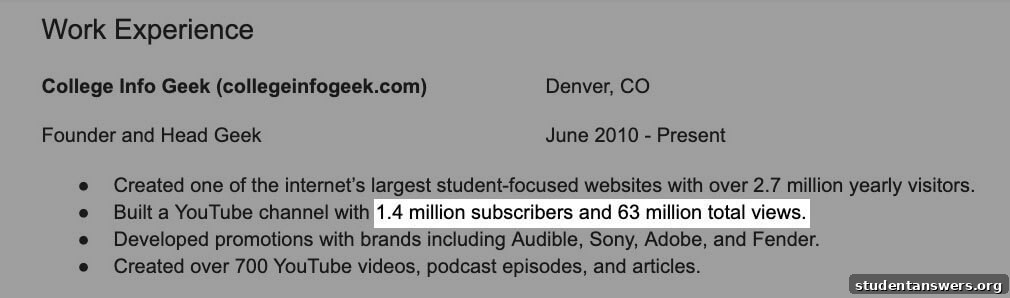
The education section is straightforward but essential. List your most recent and highest level of education first. If you’ve graduated from college, there’s no need to include your high school information. Follow this format:
- Name of University/College
- Location (City, State)
- Degree Earned (e.g., Bachelor of Science in Computer Science)
- Graduation Date (Month, Year)
- GPA (Optional)
A common question is whether to include your GPA. A good rule of thumb is to include it if it’s a 3.2 or higher. If it’s lower, it’s better to leave it off and let your experience speak for itself. For recent graduates with limited work experience, you can also add a line for “Relevant Coursework” to showcase academic projects that align with the job description.
3. Skills: Highlighting Your Technical Abilities
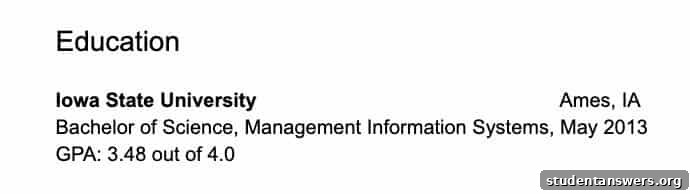
The skills section is a quick-scan area for recruiters to see if you have the specific technical competencies required for the job. This section should focus on “hard skills”—teachable, measurable abilities. Avoid “soft skills” like “good communicator” or “team player.” You should demonstrate those through your experience bullet points and during the interview.
Organize your skills into categories for readability. Here are some examples:
- Programming Languages: Python, JavaScript, Java, C++
- Software: Adobe Creative Suite (Photoshop, Illustrator), Microsoft Office Suite (Excel, Word), Salesforce
- Languages: Spanish (Fluent), French (Conversational)
- Certifications: Google Analytics Certified, PMP Certification
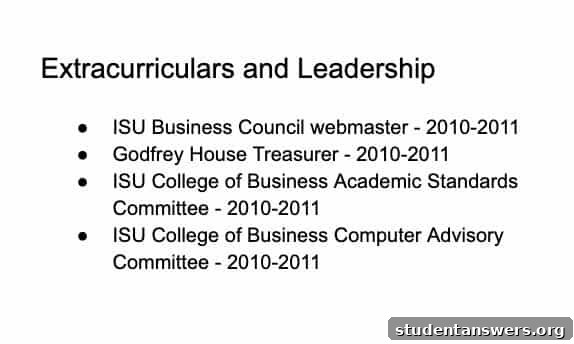
4. Extracurricular Activities & Leadership
For students or recent graduates, this section can be incredibly valuable. It fills the space if you have limited formal work experience and demonstrates important transferable skills. Include leadership roles in clubs, participation in sports teams, student government positions, or significant community involvement.
Frame these experiences to highlight skills like teamwork, project management, leadership, and time management. For example, being the treasurer of a club shows financial responsibility and organizational skills.
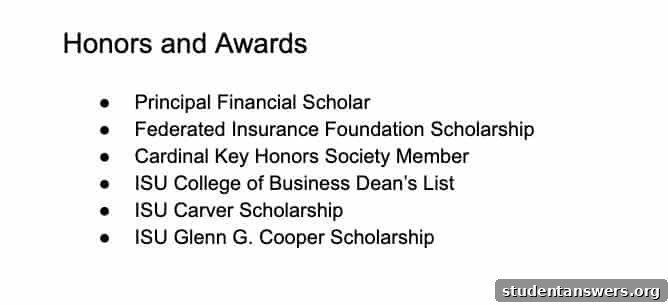
5. Honors & Awards: Your Achievements at a Glance
This final section is your chance to include any impressive recognitions you’ve received. This could include being on the Dean’s List, receiving academic scholarships, winning a competition, or being inducted into an honor society.
Keep this section brief and focused on awards that are relevant or particularly noteworthy. It provides another data point that paints you as a high-achieving candidate.
Answering Your Top Resume Questions (FAQ)
Crafting a resume often brings up a lot of questions. Here are answers to some of the most common ones we hear.
How Long Should My Resume Be?
For the vast majority of people, especially those with less than 10 years of experience, the answer is simple: one page. Recruiters spend only seconds scanning each resume, so you need to be concise and impactful. A one-page limit forces you to be selective and include only the most relevant information. If you’re a senior-level executive with decades of extensive experience, a two-page resume may be acceptable, but for students and early-career professionals, stick to one page.
Should I Use a Creative or Traditional Resume Format?
This depends heavily on your industry. If you’re a graphic designer, a visually creative resume can double as a portfolio piece. However, for most professions (finance, law, engineering, healthcare), a clean, traditional, and professional format is the safest and most effective choice. Prioritize readability over flashy design. Use a standard font like Arial, Calibri, or Times New Roman in a 10-12 point size. When in doubt, go with a classic template.
Should I Tailor My Resume for Each Job Application?
Yes, absolutely. This is non-negotiable if you want to maximize your chances. Sending a generic resume to dozens of companies is one of the biggest mistakes job seekers make. Read the job description carefully and identify the key skills and qualifications the employer is looking for. Then, adjust your resume to highlight how your experience matches those specific requirements. Use the same keywords from the job description to get past automated Applicant Tracking Systems (ATS).
What if I Have No “Real” Work Experience?
Many students feel this way, but “experience” is broader than you think. You likely have valuable skills and accomplishments, you just need to frame them correctly. Consider including:
- Internships: Even unpaid or short-term internships are valuable.
- Volunteer Work: Shows initiative and commitment.
- Academic Projects: A major research paper or a complex coding project can demonstrate relevant skills.
- Part-Time Jobs: A retail or food service job taught you customer service, time management, and responsibility.
- Freelance Work: Any projects you’ve done for clients count as professional experience.
Focus on the transferable skills you gained from these activities and present them professionally in your experience section.
From Good to Great: 3 Pro Tips to Make Your Resume Unforgettable
You’ve got the sections down and the content in place. Now, let’s add the final polish that will elevate your resume from good to great.
1. Proofread Like Your Job Depends on It (Because It Does)
A single typo can be enough to get your resume tossed in the “no” pile. It suggests a lack of attention to detail. Follow a rigorous proofreading process:
- Read It Out Loud: This forces you to slow down and helps you catch awkward phrasing and errors your brain might skip over when reading silently.
- Use a Grammar Tool: Run your text through a tool like Grammarly to catch spelling and grammatical mistakes.
- Get a Second Pair of Eyes: Ask a trusted friend, family member, or professor to read it over. A fresh perspective can spot mistakes you’ve missed.
2. Use Your University’s Career Services

Your college’s career center is an incredibly valuable and underutilized resource. Their staff are trained professionals who can provide expert feedback on your resume, conduct mock interviews, and connect you with job opportunities. You’re already paying for this service through your tuition, so take full advantage of it.
3. Leverage Your Network for Insider Feedback
The best person to critique your resume for a specific industry is someone who already works in it. Use your network to find them. Reach out to family, friends, and alumni on LinkedIn. Politely ask if they would be willing to take a quick look at your resume and offer feedback. Most professionals are happy to help students and recent graduates who show initiative.
Start Writing Your Resume Today
We’ve covered a lot of ground, from the fundamental building blocks of a resume to the pro tips that will make you stand out. The journey to landing your dream job starts with a single, powerful document. Remember to be clear, concise, and focused on your achievements.
Don’t be afraid to ask for help, whether from your career center or your professional network. With a strategic approach and a little effort, you can create a resume that not only represents you well but also opens the doors to the future you want. Now, open up that blank document and get started.